




Friday, February 1, 2013
HIGH SPIRIT

A Showcase of Women’s Excellence
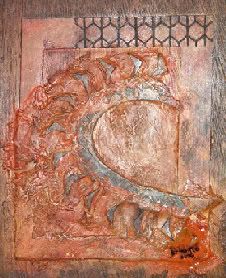
“High Spirit” the art exhibition commences public exhibition on February 1, 2013 and will go on until March 27, 2013 at the Cultural Center of the Philippines
Aurora Go Bio Shakespeare, an industrial and graphic designer from Mallorca Spain Dubai
Mimi Tecson, who recently concluded a 3-month art residency in Yokohama Japan
Celine G. Borromeo, professor and interior designer, shows her landscapes in pastel and chalk, and illustrations “For Now and Lifetimes Ago” and “Circles with Open Ends.” Athena Santos Magcase Lopez, painter and children’s book illustrator from New Jersey
Rona Buenaseda-Chua, art teacher and owner of Rona’s Art Center
“High Spirit” the exhibition represents the spirit of excellence in various modes of articulation: free/disciplined, spontaneous/designed, playful/eloquent, stimulating/harmonious, ambiguous/lucid, constructive/analytic, meditative/narrative--- qualities that are seemingly contrary, but are not mutually exclusive. The artworks selected altogether inspire its viewers into looking at art as a humanly integrative and creative process.
The exhibition can be viewed at the CCP’s second floor hallway and little theatre lobby until March 27, 2013.
WRITER’S SHRINE TO GET EPIC TREATMENT

Writer’s shrine to get epic treatment
International team of artists and designers to create park dedicated to author of Master and Margarita
By Sophia Kishkovsky. Museums, Issue 242, January 2012
Published online: 14 January 2013
The Italian architect Gabriele Filippini and his Russian wife, Olga Moskvina, who won a competition run by the Moscow
The Mikhail Bulgakov State Museum , one of two institutions in Moscow
The novel, written between 1928 and 1940, was banned until the 1960s and censored for decades afterwards. It is a satirical portrait of life under Stalin that includes a mystical interpretation of philosophical questions. The main characters include the devil, in the guise of a mysterious visitor named Woland, and Begemot, a huge talking black cat. (A magnificent furry black cat holds court in the city-funded Bulgakov museum. He also spends time in the privately funded Bulgakov museum, which is in the same building, and is happy to be petted by visitors to both.) Christ, Pontius Pilate and Judas also feature in the novel, which is one reason why it was banned.
Tuesday, January 29, 2013

Monday, January 28, 2013

Wednesday, January 23, 2013
SERRA’S THREAT TO BROAD COLLECTION

Serra’s ‘threat’ to Broad collection
Curator argues artists’ law can place “moral rights” above
historical accuracy
By Laura Gilbert. News, Issue 242, January 2012
Published online: 10 January 2013
An independent curator has claimed that Richard Serra
threatened to withdraw one of his works from the collection of Eli and Edythe
Broad if he was not allowed to rework the drawing. Magdalena Dabrowski,
speaking to an audience of lawyers and art appraisers in New York
Dabrowski organised an exhibition of drawings by Serra at New York
Some of the drawings that Serra reworked had been damaged
or destroyed, and the artist recreated them specifically for the show. The Met
hinted at this by labelling the works with two dates: that of the original and
that of the reworked version. Serra says it is not important whether audiences
know which version they are seeing. “There’s no aura of originality because
it’s an anonymous surface. It’s a difference without a value. I try to keep
surfaces as anonymous as possible,” he tells The Art Newspaper. He says he
owned the drawings he recreated, and destroyed the works they replaced.
Tuesday, January 22, 2013

Monday, January 21, 2013


Sunday, January 20, 2013
WHAT’S IN STORE FOR THE MARKET

What’s in store for the market?
The growing numbers of the super-rich should keep the
auction houses happy in 2013, but there are tougher times ahead for some
By Georgina Adam.
Comment, Issue 242, January 2012
Published online: 10 January 2013
In January 2012, the outlook for the art market was bleak,
with turmoil in the eurozone and recession in many of the world’s major
economies. Nothing changed—at the macro level, at least—throughout the year, so
art dealers finished 2012 surprised that, for many, trade was not as bad as
expected. If anything, the results at the top end of the market have never been
better; more than $1bn was spent on art during last November’s sales in New
York, with Christie’s racking up an all-time record for a contemporary art
sale, at $412m. But will we witness similar success next year?
The 1% of the 1%
I believe the top end of the art market will continue to
perform strongly, particularly in the contemporary, Impressionist and Modern
art sectors. There are a number of reasons for this. First, the building of so
many museums across the world will sustain buying. Although the reported “1,000
museums” in China Middle East , with its huge
resources, wants to establish itself as a cultural hub on a par with other,
more established centres. And billionaires’ “vanity museums”—sometimes an
unfair criticism—need to buy top works of art as well.
In this context, a recent book by Chrystia Freeland,
Plutocrats: the Rise of the New Global Super-Rich and the Fall of Everyone
Else, 2012 (Penguin Press), offers a fascinating analysis of the new global
super-rich. She sees today’s incredible wealth as the result of two
transformations: technological revolution and globalisation in the West,
coupled with an Industrial Revolution-sized burst of growth in much of the rest
of the world, leading to the convergence of two “gilded ages”.
Saturday, January 19, 2013

BATTLE LINES DRAWN TO PROTECT VIEWS OF OLE LONDON

Preservationists square off with urban planners and
developers over building skyscrapers near heritage sites like the Tower of London
By Martin Bailey. Web only
Published online: 09 January 2013
The British government is facing criticism from Unesco for
allowing the Shard, Renzo Piano’s 95-storey commercial tower, and other
skyscrapers to be built so close to the Tower of London UK
Unesco’s World Heritage Committee last year recommended
that the UK
The Shard, which will have a public viewing gallery that is
due to open to visitors in February, now looms over the medieval walls of the Tower of London Tower
of London , across the Thames near London Bridge
Preserving the views around the Tower of London
The present situation, Penrose says, lacks clarity, which
makes it difficult for developers and offers insufficient protection for the
most important views. Two years ago, English Heritage published a report to
evaluate the significance of historic urban views. Penrose now wants a more
formal solution to the problem.
Friday, January 18, 2013


Thursday, January 17, 2013

ARTISTS PRESS FOR BETTER WORKING CONDITIONS ON SAADIYAT ISLAND

Artists press for better working conditions on Saadiyat Island
The group Gulflabor has released a new letter following a
report on labour practices at future museum sites
By Helen Stoilas. Web only
Published online: 09 January 2013
As construction begins on a new $653m branch of the Louvre
museum in Abu Dhabi , a group of artists who have
spoken out against labour conditions in the Gulf released another letter
calling on all the cultural institutions opening museums on Saadiyat Island
The emirate’s Tourism, Development & Investment Company
(TDIC), which is overseeing the massive cultural development project on Saadiyat Island
Wednesday, January 16, 2013

ISTANBUL BIENNIAL TO EXPLORE THE PUBLIC DOMAIN

Istanbul Biennial to explore the public domain
Organisers launch a series of forums across the city in
lead up to event
By Gareth Harris. Web only
Published online: 08 January 2013
In contrast to the Istanbul
According to a press statement, Erdemci’s highly academic
vision will explore “the notion of the public domain as a political forum”,
touching on the notions of democracy, civilisation, barbarity, and social
engagement. An aim of the biennial is to re-examine the concept of “publicness”
(installations may also be displayed in shopping malls, hotels and office
buildings).
Tuesday, January 15, 2013
ENGLAND’S RECORD £8.6bn LOANS

Fourfold increase in value of indemnified art borrowed—and
nearly all of it returned safely
By Martin Bailey. Museums, Issue 242, January 2012
Published online: 08 January 2013
Museums and galleries in England
The increase mainly reflects the rise in prices on the art
market, particularly for major works. However, the number of venues has also
increased, largely due to new National Lottery-funded buildings, such as Tate
Modern. Works lent to national museums accounted for 75% of the £8.6bn; loans
to other venues made up the rest.
We have obtained the first detailed data on the UK ’s Government Indemnity Scheme, which is
administered by the Arts Council in England
and by the respective governments of Scotland ,
Wales and Northern Ireland UK UK
Among the exhibitions in the past financial year that
pushed up the figure was the National Gallery’s “Leonardo da Vinci: Painter at
the Court of Milan” (9 November 2011-5 February 2012).
Although only eight paintings by Leonardo were borrowed
(plus works by other artists), the works were all extremely valuable.
Monday, January 14, 2013
MIRO ON LOAN DAMAGED AT TATE MODERN

Miró on loan damaged at Tate Modern
Cost of repairs and depreciation was £203,000
By Martin Bailey. Museums, Issue 242, January 2012
Published online: 08 January 2013
An important painting by Miró was damaged in 2011 while on
loan to Tate Modern, in an incident that went unreported in the media. The work
was on loan from the Fundació Joan Miró in Barcelona
According to a visitor to the Miró retrospective, a man
leant against the picture with both hands. A spokeswoman for the Tate says that
the gallery believes it was an accident. None of the gallery’s staff witnessed
the incident.
Painting on White Background for the Cell of a Recluse I,
1968 (above), is part of a room-sized triptych, and the left-side picture is
3.5m long. The incident occurred on 7 July 2011 and the painting went back on
display eight days later, after conservation work was completed by the Tate
with advice from the Miró foundation. The conservation work would have cost a
few thousand pounds, so the £203,000 indemnity payment by the UK
After London , the Miró
retrospective travelled to Barcelona Washington , DC
Subscribe to:
Posts (Atom)


