NEWS

Thursday, November 6, 2008

KULAY BAHAGHARI


Inspired by her recent residency in Colarado, USA which brought her into contact with several Western painters, sculptors and ceramists, Filipino potter Winnie Go has opted for a dazzling blaze of colour for the ceramics in her next solo exhibition. Using glaze and underglaze as her paints upon clay, Winnie has created a brilliant series derived from modernist and geometric abstraction, with retro angular shapes and patterns, and also drips and splashes decorating the surface of her hand-built slabs, wheel-turned vessels and a small number of singular sculptural pieces. Breaking out from a rather zen and conservative Eastern tradition with regards to colour on ceramics, Winnie’s latest rainbow collection of works assails the senses with vivid primary colours and festive joie de vivre.

Winnie Go trained at the Jon Pettyjohn Pottery Workshop in Laguna, Philippines from 1995-2000, and has attended the Paul Davis Workshop in Australia (2002) and Anderson Ranch, Colorado, USA (2008) for further ceramic training. She has participated in several group shows in Singapore and the Philippines, and is a member of the Nanyang Clay Group. Kulay Bahaghari is her third solo show, and first in Singapore.


KULAY BAHAGHARI
COLOURS OF THE RAINBOW
Adventures in colour by
Filipino ceramist WINNIE GO

Thursday 6th November 2008 7 pm
Mon-Sat 12 noon - 8 pm Sun 12 noon - 5.30 pm
The exhibition runs to Sunday 16th November 2008.

Wednesday, November 5, 2008

A CELEBRATION OF LIFE


A CELEBRATION OF LIFE

Ernie Gomez
Bumbo Villanueva

Le Souffle, Rockwell Powerplant, Makati City

Opening Reception
Saturday, November 8, 2008, 5:00 – 7:00 p.m.
Exhibit Extends
November 9 – 30, 2001

Tuesday, November 4, 2008

RECLAMATION PROJECT


ALFREDO ESQUILLO JR. 'RECLAMATION PROJECT'

Alfredo Esquillo Jr.’s 12th solo show, Reclamation Project, opens at Tin-aw Art Gallery in Makati at 6pm on Friday, November 7, 2008. The multi-awarded artist will exhibit new works in oil on canvas, pelon fabric, and rubber. With Reclamation Project, Esquillo revisits the various artistic directions he has taken in his 15-year career – from his autotheater, archival works, and folk-religious themes.

For inquiries about Reclamation Project please contact Tin-aw Art Gallery at the Upper Ground Floor, Somerset Olympia Building, Makati Avenue, Makati City. Contact 8927522 or email info@tin-aw.com. Website www.tin-aw.com. Admission is free.

Monday, November 3, 2008

INVASION


ronaldo ruiz
INVASION
17th one-man show
NOVEMBER 4 - 15 '08
@ renaissance gallery 4th level bldg. a, sm megamall, mandaluyong city
tel. no. ( 632) 6373101

Sunday, November 2, 2008

LIKE


Pamela Yan Santos' Like

In her upcoming solo exhibition entitled LIKE, Pamela Yan Santos explores personal history as known and remembered through various indices such as photographs, written and scribbled language and other signifiers that many of us consider as mundane.

Working in mixed media and in layers, she uses the processes of serigraphy, painting and collage as components to a kind of visual syntax intended to essay personal episodes and remembrances of emotional significance. The approaches through which she interrelates the various processes make the works resonate as wish, as a point of comparison, as a mnemonic or as a conjunction, which are among the permutations of the word LIKE.

From a personal perspective, the works bridge the artist's past and present by transforming events through time into a synchronous testament, expressing how agreeably or uncannily the two echo and mirror each other.

Pam Yan -Santos graduated with a degree in Bachelor of Fine Arts Major in Painting from the University of the Philippines. A prize winner in the print category of the 1993 AAP Annual Art Competition, she has joined significant number of group exhibitions both here and abroad, the latest of which is ArtBeijing in China.

LIKE is Pam's 5th solo exhibition and will be curated by Leo Abaya.

LIKE opens on Monday, November 3, 2008 6PM at the blanc compound 359 Shaw Blvd, Mandaluyong City. For More information please call/sms 752-0032/0920- 9276436, email info@blanc.ph or visit www.blanc.ph.

Saturday, October 18, 2008

MUGNANG-HALAD


“MUGNANG HALAD” Art Raffle and Exhibit
ART CENTER, SM CITY CEBU
OCTOBER 24 – NOVEMBER 7, 2008


The Organizers of the 2008 VIVA (Visayan Islands Visual Artists) Exhibit-Conference in Cebu together with its artist’s friends from the Visayas and the rest of the country have initiated a fund-raising campaign to help subsidize the delegates and activities of the longest running exhibit conference in the country. With “Mugnang-Halad” an art raffle and exhibit, art works will be raffled off for the price of PhP3,000.00 per ticket. This is your chance to start or enhance your contemporary art collection and support the continuing education of artists through the VIVA Ex-Con.


"MUGNANG-HALAD" RAFFLE MECHANICS

The art works to be raffled will be exhibited at the Art Center, 2nd Level of SM City Cebu from October 24-November 6, 2008.

To join simply purchase a single raffle ticket worth P3, 000.00. You can buy your raffle tickets at Kukuk’s Nest Restaurant or from any Pusod, Inc. officers.
There are six (6) sets of prizes (art works) to be won. One set is composed of six art works pre-chosen by the organizers.

A drawn raffle ticket is entitled to win 1 set of art works only from any of the six (6) draws.
Relatives of the Organizers up to the third degree of consanguinity are disqualified from the raffle.

Winning sets may not be returned or exchanged to the Organizing Committee for other art works in other sets. However, a holder of a winning raffle ticket may negotiate a trade or barter of art works from other holders of winning raffle tickets provided they do not involve the Organizing Committee in the transaction.

Winning set(s) of art works not claimed within 60 days from the raffle date will automatically become the property of Pusod Inc. The organizers will have absolute authority to dispose of the works however they see fit.

The six raffle draws will be on November 7, 2008 starting at 6 o’clock in the evening at the Conference Hall “D” of SM City Cebu.

Proceeds of the raffle will benefit the delegates and activities of the Visayas Islands Visual Artist Exhibit-Conference (VIVA Ex-Con) in Cebu.

A10% commission will be given to any individual or group that can sell/purchase twenty five tickets in bulk.

Deadline for the submission/return of unsold tickets to the Organizers must be made within November 4, 2008.

For more ticket information, email us at pusod_inc@yahoo.com or call the VIVA Secretariat at 09173295626.


The Raffle Draw Sets:
Set A – Pandy Aviado, Javy Villacin, Jet Florendo, Adeste Deguilmo, Estela Ocampo-Fernandez, Boy Kiamko

Set B –Eghai Roxas, Ross Capili, Kimsoy Yap, Karl Roque, Boy Kiamko, Radel Paredes

Set C – Charlie Co, Andrew Barba, Gabriel Abellana, Evan Bejec, Benjie Goyha, Tito Cuevas

Set D – Nune Alvarado, Red Mansueto, Raymund Fernandez, Celso Pepito, Boy Kiamko, Joshua Cabrera

Set E – PG Zoluaga, Sio Montera, Caesar Velez, Jun Impas, Lucilo Sagayno, Jethro Estimo

Set F – Egai Fernandez, Dennis Ascalon, George Lao, Ritchie Quijano, Ramon De Dios, Palmy Tudtud

Friday, October 17, 2008

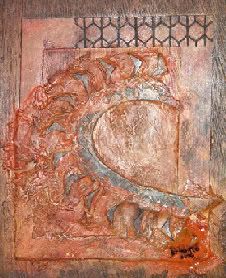
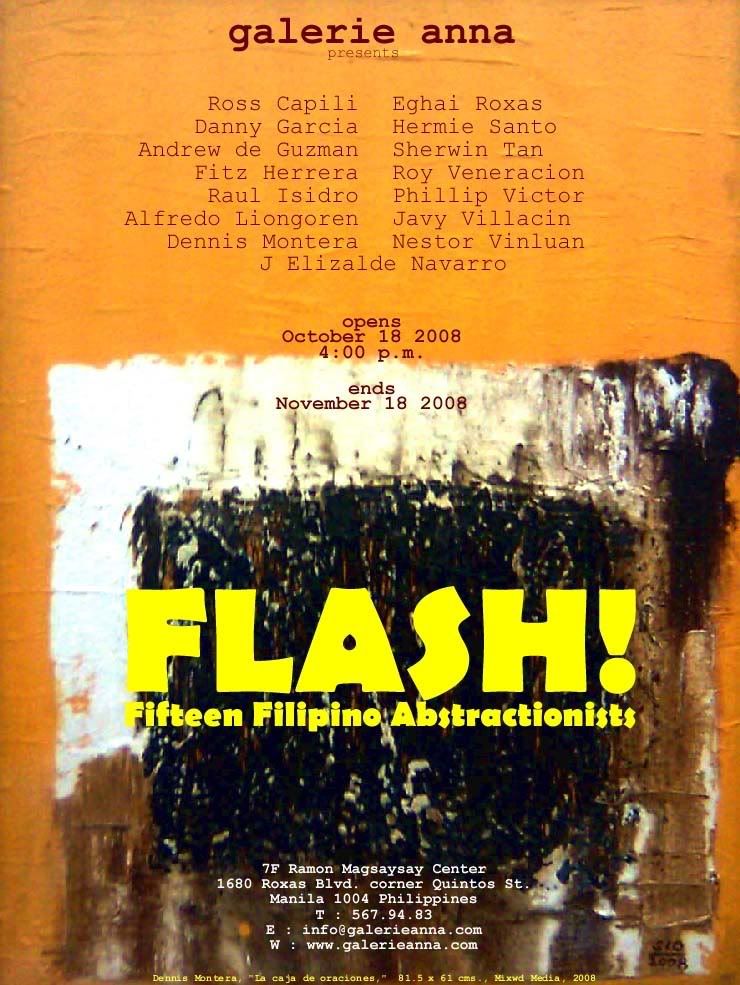
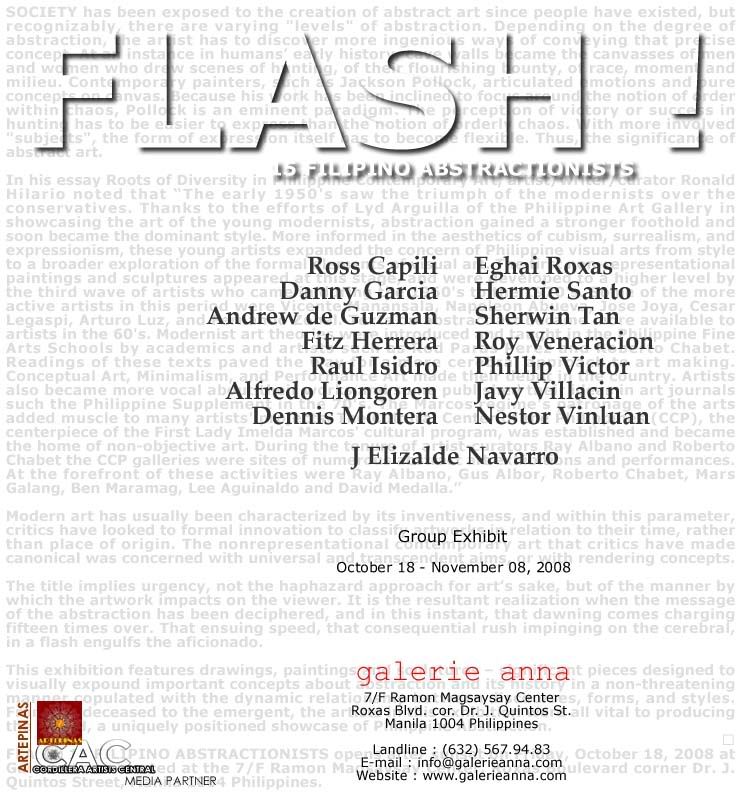
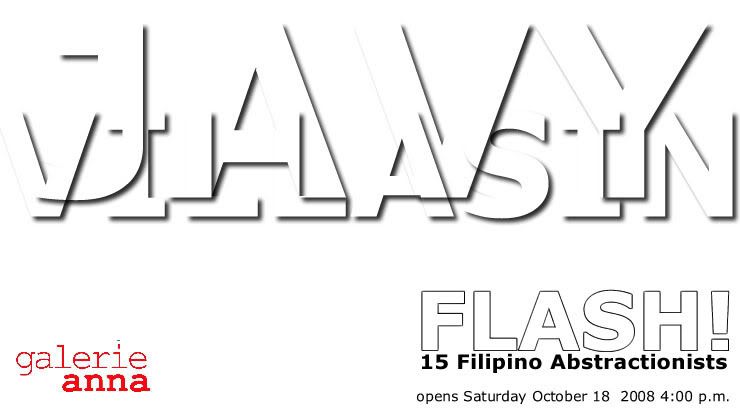
FLASH! FIFTEEN FILIPINO ABSTRACTIONISTS


SOCIETY has been exposed to the creation of abstract art since people have existed, but recognizably, there are varying "levels" of abstraction. Depending on the degree of abstraction, the artist has to discover more ingenious ways of conveying that precise concept. At an instance in humans’ early history, cave walls became the canvasses of men and women who drew scenes of hunting, of their flourishing bounty, of race, moment and milieu. Contemporary painters, such as Jackson Pollock, articulated emotions and pure concepts on canvas. Because his work has been inclined to focus around the notion of order within chaos, Pollock is an eminent paradigm. The perception of victory or success in hunting has to be easier to express than the notion of orderly chaos. With more involved "subjects", the form of expression itself has to become flexible. Thus, the significance of abstract art.

In his essay Roots of Diversity in Philippine Contemporary Art, artist/writer/curator Ronald Hilario noted that “The early 1950's saw the triumph of the modernists over the conservatives. Thanks to the efforts of Lyd Arguilla of the Philippine Art Gallery in showcasing the art of the young modernists, abstraction gained a stronger foothold and soon became the dominant style. More informed in the aesthetics of cubism, surrealism, and expressionism, these young artists expanded the concern of Philippine visual arts from style to a broader exploration of the formal elements of visual art. The first non-representational paintings and sculptures appeared at this stage, and were developed to a higher level by the third wave of artists who came in during the 1960's to the 1970's. Some of the more active artists in this period were Vicente Manansala, Napoleon Abueva, Jose Joya, Cesar Legaspi, Arturo Luz, and Fernando Zobel. Texts on abstract art became more available to artists in the 60's. Modernist art theories were introduced and taught in the Philippine Fine Arts Schools by academics and artists such as Rod Paras Perez and Roberto Chabet. Readings of these texts paved the way for a more cerebral approach to art making. Conceptual Art, Minimalism, and Performance Art made their debut in the country. Artists also became more vocal about their works and some published their ideas in art journals such the Philippine Supplement in the 70's. The Marcos regime's patronage of the arts added muscle to many artists' projects. The Cultural Center of the Philippines (CCP), the centerpiece of the First Lady Imelda Marcos' cultural program, was established and became the home of non-objective art. During the tenure of artist-curators Ray Albano and Roberto Chabet the CCP galleries were sites of numerous abstract art exhibitions and performances. At the forefront of these activities were Ray Albano, Gus Albor, Roberto Chabet, Mars Galang, Ben Maramag, Lee Aguinaldo and David Medalla.”

Modern art has usually been characterized by its inventiveness, and within this parameter, critics have looked to formal innovation to classify artworks in relation to their time, rather than place of origin. The nonrepresentational contemporary art that critics have made canonical was concerned with universal and transcendent aims, or with rendering concepts.

The title implies urgency, not the haphazard approach for art’s sake, but of the manner by which the artwork impacts on the viewer. It is the resultant realization when the message of the abstraction has been deciphered, and in this instant, that dawning comes charging fifteen times over. That ensuing speed, that consequential rush impinging on the cerebral, in a flash engulfs the aficionado.

This exhibition features drawings, paintings and sculptures – significant pieces designed to visually expound important concepts about abstraction and its history in a non-threatening manner copulated with the dynamic relationship between discourses, forms, and styles. From the deceased to the emergent, the artists in this exhibition were all vital to producing the FLASH, a uniquely positioned showcase of Philippine Abstraction.

Ross Capili, Danilo Garcia, Andrew de Guzman, Fitz Herrera, Raul Isidro, Alfredo Liongoren, Sio Montera, J Elizalde Navarro, Eghai Roxas, Hermi Santo, Sherwin Tan, Roy Veneracion, Phililip Victor, Javy Villacin and Nestor Olarte Vinluan.

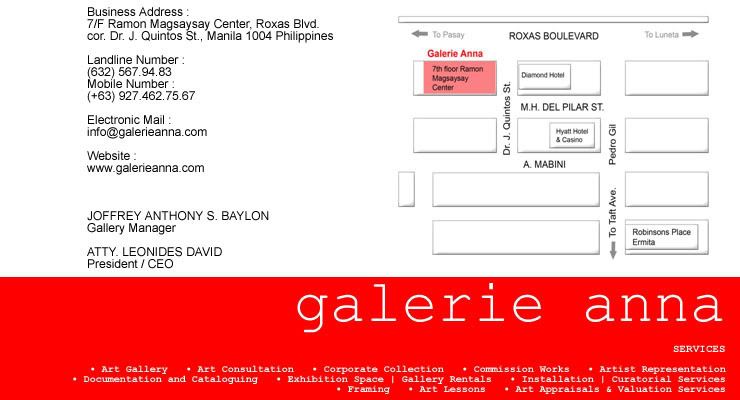
FLASH! Fifteen Filipino Abstractionists shall be on view starting October 18, 2008 at Galerie Anna, 7th floor, Ramon Magsaysay Center, Roxas Boulevard corner Dr. J. Quintos Street, Manila 1004 Philippines. For more information and queries about the gallery and the exhibition, you can log on to www.galerieanna.com, contact Gallery Manager Mr. Joffrey Baylon at landline number (632) 5679483, or email at info@galerieanna.com.


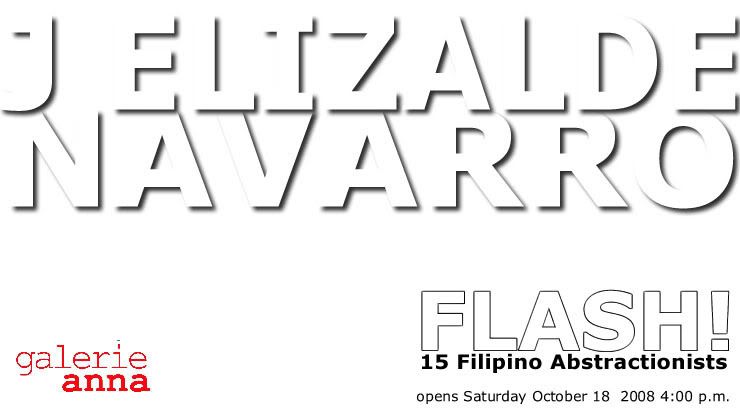
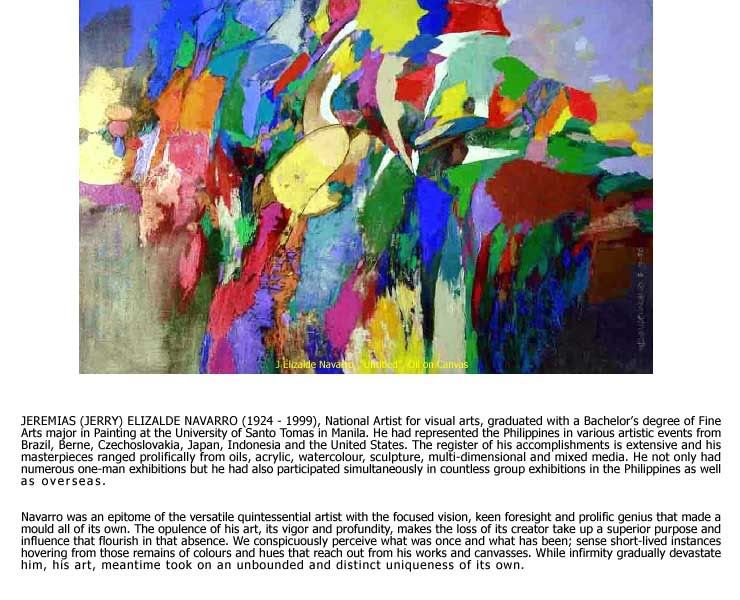
FLASH! J ELIZALDE NAVARRO


Jeremias (Jerry) Elizalde Navarro (1924 - 1999), National Artist for visual arts, graduated with a Bachelor’s degree of Fine Arts major in Painting at the University of Santo Tomas in Manila. He had represented the Philippines in various artistic events from Brazil, Berne, Czechoslovakia, Japan, Indonesia and the United States. The register of his accomplishments is extensive and his masterpieces ranged prolifically from oils, acrylic, watercolour, sculpture, multi-dimensional and mixed media. He not only had numerous one-man exhibitions but he had also participated simultaneously in countless group exhibitions in the Philippines as well as overseas.

Navarro was an epitome of the versatile quintessential artist with the focused vision, keen foresight and prolific genius that made a mould all of its own. The opulence of his art, its vigor and profundity, makes the loss of its creator take up a superior purpose and influence that flourish in that absence. We conspicuously perceive what was once and what has been; sense short-lived instances hovering from those remains of colours and hues that reach out from his works and canvasses. While infirmity gradually devastate him, his art, meantime took on an unbounded and distinct uniqueness of its own.


Thursday, October 16, 2008

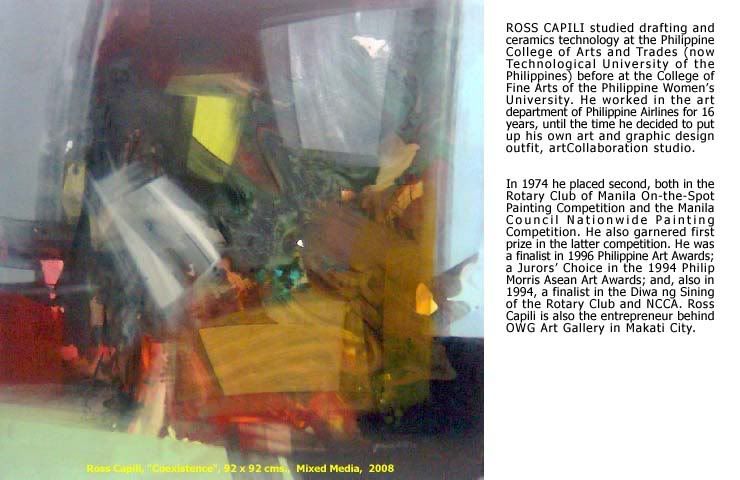
FLASH! ROSS CAPILI


ROSS CAPILI studied drafting and ceramics technology at the Philippine College of Arts and Trades (now Technological University of the Philippines) before at the College of Fine Arts of the Philippine Women’s University. He worked in the art department of Philippine Airlines for 16 years, until the time he decided to put up his own art and graphic design outfit, artCollaboration studio.

In 1974 he placed second, both in the Rotary Club of Manila On-the-Spot Painting Competition and the Manila Council Nationwide Painting Competition. He also garnered first prize in the latter competition. He was a finalist in 1996 Philippine Art Awards; a Jurors’ Choice in the 1994 Philip Morris Asean Art Awards; and, also in 1994, a finalist in the Diwa ng Sining of the Rotary Club and NCCA. Ross Capili is also the entrepreneur behind OWG Art Gallery in Makati City.


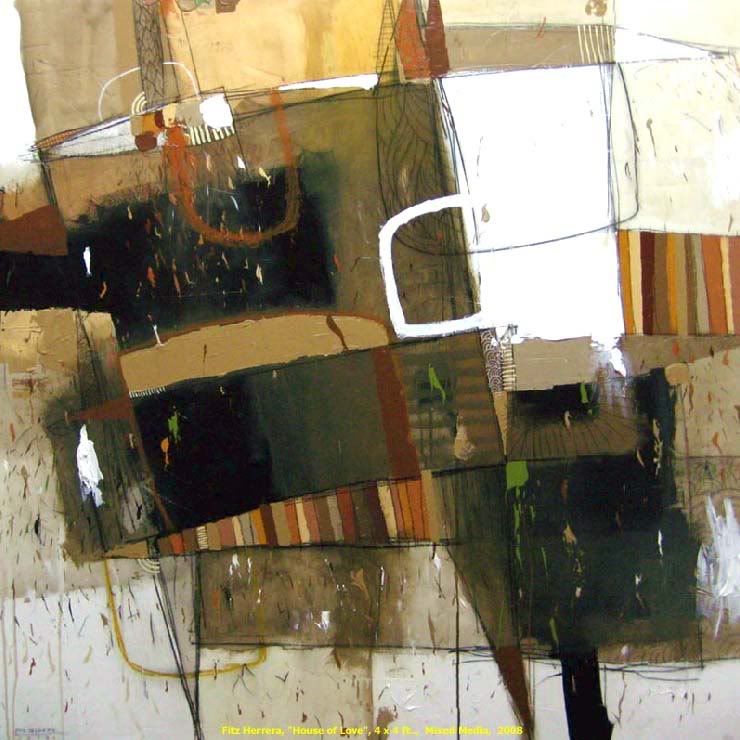
FLASH! FITZ HERRERA

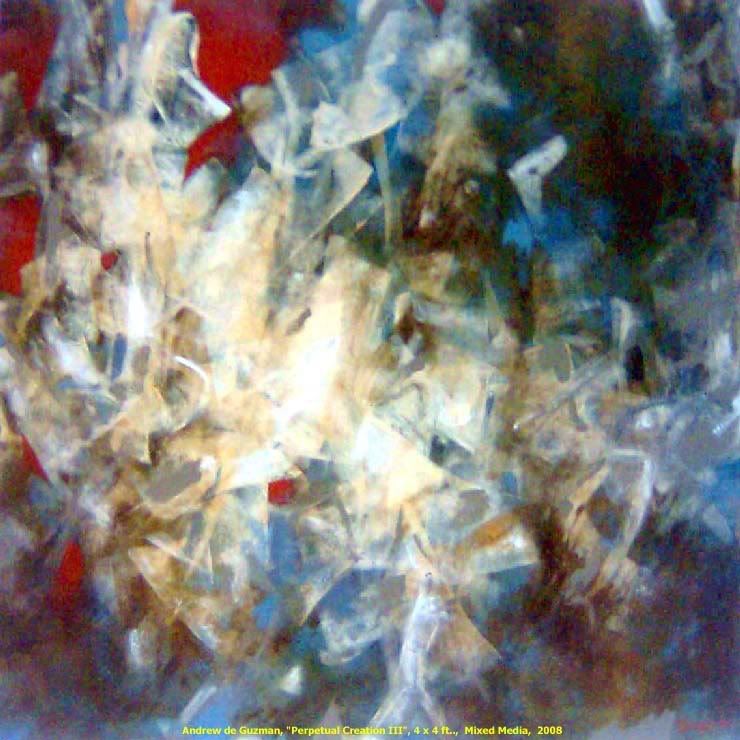
FLASH! ANDREW DE GUZMAN

Wednesday, October 15, 2008

FLASH! PHILLIP VICTOR


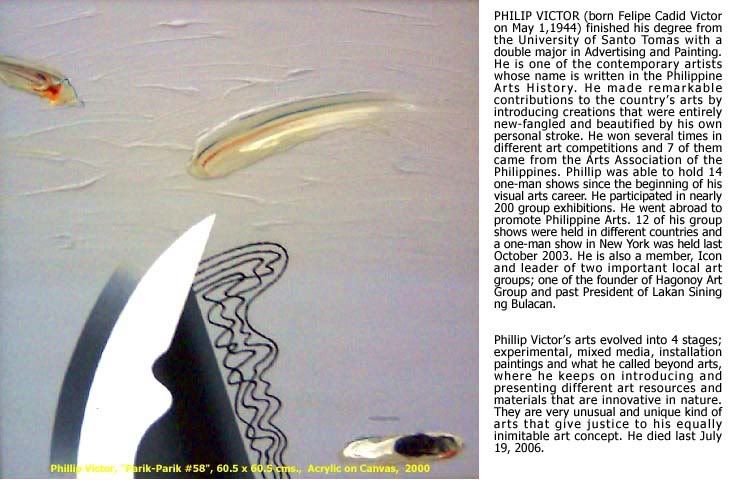
PHILIP VICTOR (born Felipe Cadid Victor on May 1, 1944) finished his degree from the University of Santo Tomas with a double major in Advertising and Painting. He is one of the contemporary artists whose name is written in the Philippine Arts History. He made remarkable contributions to the country’s arts by introducing creations that were entirely new-fangled and beautified by his own personal stroke. He won several times in different art competitions and 7 of them came from the Arts Association of the Philippines. Phillip was able to hold 14 one-man shows since the beginning of his visual arts career. He participated in nearly 200 group exhibitions. He went abroad to promote Philippine Arts. 12 of his group shows were held in different countries and a one-man show in New York was held last October 2003. He is also a member, Icon and leader of two important local art groups; one of the founder of Hagonoy Art Group and past President of Lakan Sining ng Bulacan.

Phillip Victor’s arts evolved into 4 stages; experimental, mixed media, installation paintings and what he called beyond arts, where he keeps on introducing and presenting different art resources and materials that are innovative in nature. They are very unusual and unique kind of arts that give justice to his equally inimitable art concept. He died last July 19, 2006.


Tuesday, October 14, 2008

FLASH! EGHAI ROXAS


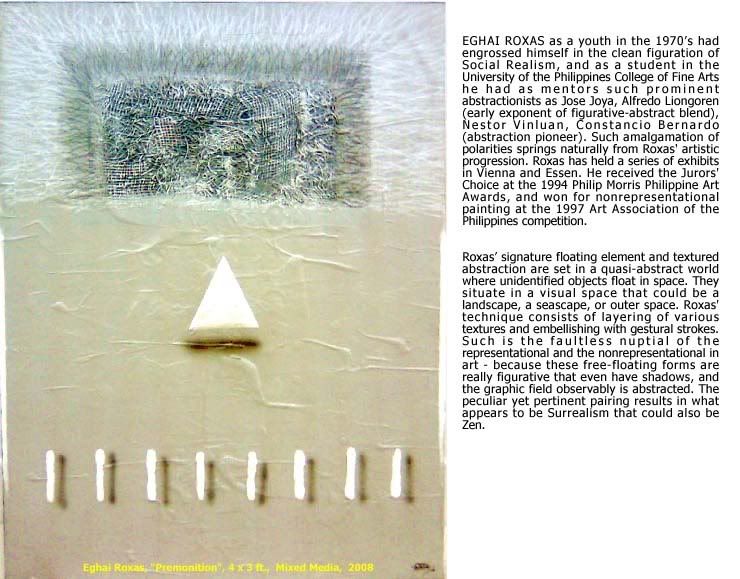
EGHAI ROXAS as a youth in the 1970’s had engrossed himself in the clean figuration of Social Realism, and as a student in the University of the Philippines College of Fine Arts he had as mentors such prominent abstractionists as Jose Joya, Alfredo Liongoren (early exponent of figurative-abstract blend), Nestor Vinluan, Constancio Bernardo (abstraction pioneer). Such amalgamation of polarities springs naturally from Roxas' artistic progression. Roxas has held a series of exhibits in Vienna and Essen. He received the Jurors' Choice at the 1994 Philip Morris Philippine Art Awards, and won for nonrepresentational painting at the 1997 Art Association of the Philippines competition.

Roxas’ signature floating element and textured abstraction are set in a quasi-abstract world where unidentified objects float in space. They situate in a visual space that could be a landscape, a seascape, or outer space. Roxas' technique consists of layering of various textures and embellishing with gestural strokes. Such is the faultless nuptial of the representational and the nonrepresentational in art - because these free-floating forms are really figurative that even have shadows, and the graphic field observably is abstracted. The peculiar yet pertinent pairing results in what appears to be Surrealism that could also be Zen.


Monday, October 13, 2008

FLASH! DANILO GARCIA


DANILO O. GARCIA took up Fine Arts (major in advertising) initially at the University of Santo Tomas and moved to the newly opened Fine Arts department at the University of the East on his third year. He joined the 1971 Shell art competition and won an award for a painting in mixed media. After he dropped out from the university, he participated in a number of group shows, notably those of Grupo Ocho, an eight-man band of artists from the UE with strong experimental leanings in contemporary art expression. In his third one-man show in 1981 Garcia's paintings had fully shifted to abstraction. Totally abandoning figurative painting, his show at the Luz gallery used acrylic, canvas, masking tape and string to create lines and shapes of controlled tonal variations, graceful rhythms and smooth contrasts.

In ensuing one-man exhibits, Garcia delved into the varying character of the circle, the square, the oval, and the straight and curved lines in different combinations and contexts, in concordant and well-balanced visual and conceptual interactions of moment and space even as they richly alluded to the terrestrial and extra-terrestrial worlds and the meta physical realm. In all of these works, precision and refinement mark Garcia's execution, forms mimicking mechanically produced airbrush art, but were definitely a result of his uncanny skill and talent with the paintbrush. From his brown monochromes of earlier years, his color evolved to the elegance of monochromes while exploring the tonalities of the rainbow spectrum.


FAITH IN A FLASH : PHILIPPINE ABSTRACTION IN THE PO-PO-MO GLOBE


FAITH IN A FLASH
Philippine Abstraction in the Po-Po-Mo Globe
Reuben Ramas Cañete


“…the built environment professions are witnessing the gradual dawn of a post-Postmodernism that seeks to temper reason with faith”
Tom Turner, City as Landscape: A Post Post-modern View of Design and Planning (Taylor & Francis: London 1995), p. 9.


Reports of the death of Abstraction, to paraphrase a quote by Mark Twain, have been greatly exaggerated. The dominance of Postmodernism in the late 20th Century that has been characterized (often by furious orthodox purists) as a chaotic and irreverent jumble of sources, styles, and narratives had often implied the demise of this most distinctive—and totalitarian—of Modern art movements. The charge is centered on the monolithic construct that Abstraction has been wrapped in ever since Clement Greenberg infamously associated figurative art with kitsch, and elevated the avant-garde as the historical fulfillment of modernity’s zeitgeist—an avant-garde located primarily and purely in the non-objective aesthetics of Kandinsky, Hoffmann, Gorky, and Pollock.

By contrast, Postmodern art, in its implicit critique of Modernism’s patriarchal intolerance, advocated the return of subject matter, representation, and narrative in art, and the fusion (some would say mix-match) of several styles and genres together to foreground an aesthetics of difference and hybridity. If one can define a style by its opposition, Postmodernism’s appeal lies precisely in “its (inclusion of) the ironic play with styles, citations and narrative levels, a metaphysical skepticism towards the ‘grand narratives’ of Western culture, a preference for the virtual at the expense of the real, and a ‘waning of affect’ on the part of the subject, who is caught up in the free interplay of virtual, endlessly reproducible signs inducing a state of consciousness similar to schizophrenia.”

It is thus no wonder that, in the past fifteen years, a growing chorus of complainants about Postmodernism’s own increasing faddish dominance has arisen, and attempted to articulate this opposition to Modernism’s nemesis through the concept of Post-Postmodernism, or “Po-Po-Mo.” “Po-Po-Mo” is supposedly a theory that recuperates from Postmodernism’s epistemological violence against Modernism by emphasizing the (Modernist) values of “faith, trust, dialogue, performance or sincerity (that)…can work to transcend postmodern irony.” Articulated by such critics as architectural scholar Tom Turner, the Russian-American literary critic Mikhail Epstein, American cultural theorist Eric Gans (who calls it “post-millenialism”), German-American Slavist Raoul Eshelman (who calls it “performatism”), radio talk-show host Jesse Thorn (who calls it “New Sincerity”), and British cultural historian Alan Kirby (who calls it “pseudo-modernism”), the various strains of critique against Postmodernism through “Po-Po-Mo” resolve their common stance through the following key concepts: the return of order and regularity; the demise of irony and free play, and the reiteration of "trans-subjectivity," "trans-idealism," "trans-utopianism," "trans-originality," "trans-lyricism," "trans-sentimentality"; a rejection of “victimary discourse”; a unified, aesthetically mediated experience of transcendence through the experience of beauty, love, belief and transcendence under particular, artificial conditions; the promotion of “good feelings”; and a pessimistic view of instantaneity and social cohesion brought about by technological interventions in social discourse.

Doubtless, such assertions are based on (an admittedly Occidental-centric) viewpoint that is at best testy, and at worse in denial of the conditions of the contemporary (Po-Po)Modern world left in inequilibrium after the unitary triumphalism of western global capitalism that still leaves pockets of uneven material relations across the supposedly harmonized planet. Po-Po-Mo’s attraction lies in its recall of eternal verities and universal validations that came under ceaseless attack from the Po-Mos, an attack that uncovered Modernism’s uncritical and untheorized power-positionality in discourse and agency, but which also left Po-Mo open to counter-attack from neo-conservatives who feel that Po-Mo’s concepts of hybridity and heterogeneity allows them the license to “articulate their voices differently as marginal discourse vis-à-vis the centrality of irony and grand narration of Postmodern practice.”

In this atmosphere where Modernism’s values are once again resurgent in the face of neo-con’s collective counter-thrust, it is an apt development that the term “faith” has once more entered the epistemic vocabulary, and the central arena of debate between the parrying parties. This turn is important, not only to Modernism, but also to Postmodernism (and thus to Po-Po-Mo) because it shifts the focus of the debate from material issues (where things easily bog down again thanks to the ambivalent position by both sides to Marxian political economy) to metaphysics, where much territory has yet to be illuminated and re-charted. Po-Po-Mos, in their collective eagerness (or indifference, for that matter) to deconstruct Postmodernism’s debilitating critiques of Modernist preordination, inadvertently reopen the one linkage that actually bridges the artificial divide between resurgent modernity and threatened postmodernity: the issue of belief.

Pierre Bourdieu, in his essay “The Production of Belief”, articulates the formation of artistic practice through a “(practice of) negotiation…(that) can only work by pretending not to be doing what they are doing.” This is based on what Bourdieu sees as the “economism (that) lies precisely in the fact that they function…in practice…only by virtue of a constant, collective repression of narrowly ‘economic’ interest and of the real nature of the practices revealed by ‘economic’ analysis.” What this means is that terms like “art” (or for that matter “religion”, “politics”, or even “life”) are made, not by some mystical and changeless process, but by an active process of continuing historical relations between “stakeholders”, including those who are left out of the process of naming, and thus as liable to “(re)define” the term not by their presence but by their “absence,” as Derrida would put it.

It is this interlinking between absent, present, visible, and invisible that we now turn to in our current understanding of the exhibition “FLASH: Fifteen Filipino Abstractionists.” An exhibition of artworks like these in the present (2008) would normally not ruffle any feathers, considering that Philippine Abstraction as a social phenomenon has yet to produce the same level of alienation and irony that Western Abstraction had achieved in Europe and the United States by the end of World War I. Indeed, despite Abstraction’s relatively early presence in the Philippine Art Scene (note Magtanggul Asa’s 1952 catalogue to the “Non-Objective Art in Tagala” exhibition at the Philippine Art Gallery, for example), it has only been the past 22 years since the EDSA Revolution that Abstraction has gained something of a popular audience, primarily through the advocacies of interior designers, real estate developers, and young professional art collectors.

However, the recent assertion of Po-Po-Mo “theory” through a small (albeit vocal) minority within the Manila art scene necessitates this writer’s response to its validation. Composed of self-proclaimed “independent artists running independent art spaces”, they assert that Abstraction’s resurgence is due primarily to the historical and material error that Postmodernism has found itself in the Philippine context, explaining away the “proliferation of art spaces and artists” in Manila as a consequence of the inevitable (and thus ‘real’ and ‘true’) modernization of the country. This smug self-assessment ignores the long history of contradictions that Modernism has had to undergo in the Philippines: borne out of imperialism and colonialism; injected through foreign-based exploitative capital extraction; and subject to this system’s capture by the ‘national bourgeoisie’ in a classic Postcolonial gesture of the doubled mimic, Modernism has had to struggle to find contextual relevance as the nation’s dysfunctional nexus to a quasi-cosmopolitan ethos. Imelda Marcos’ patronage excesses in the 1970s at the expense of the social fabric’s wellbeing only highlighted Abstraction’s “modern” (that is to say, universal and homogenous) disjuncture with the nation’s ‘modernity’. In hindsight, Po-Po-Mo’s self-congratulatory evaluation hinges upon not an increasing modernization of the nation as a whole, but of an increasing gulf of separation between high art patronage and popular cultural consumption.

This background is necessary as we assess the role in which Abstraction plays out in the background of disasters, dysfunctionalities, and dichotomic relations between Modernism and its minoritized interpellators. We should ask ourselves not only the relevant material questions (i.e. what role did Abstraction play in the legitimation of totalitarian power in Philippine political and artworld life?), but more crucially, on what kind of “economy” (as Bourdieu would call it) was this relationship based upon. This requires not only a rejection of the hitherto ‘classical’ distinction between representation as ‘truthful’ documents of social process and abstraction as ‘pure form’ that responds only to internationalist codes of universal humanist pretension. Rather, we should evaluate and situate Abstraction in the Philippines as an accessionary and exchangeable practice grounded in a conviction of its metaphysical effects on the material economy of artworld practitioners. This requires our understanding of a word that many (High/Post/Po-Po)Modernists would rather leave unanswered: the role of belief in artmaking at the Postcolonial turn.

In the case of the first-generation Abstractionists like Jerry Navarro, that belief was engendered by the liberative potential that Abstraction provided to those whose habitus was burdened by the weight of earlier Modern traditions, like the sensual folk figurism of Carlos “Botong” Francisco. Abstraction in the 1950s was a liberating experience that allowed the individual to rise above the collective homogeneity of an artificially induced ‘national style’, its avant-garde stature ensuring the requisite symbolic return for its pioneering practitioner to exchange with catachrestic social sufferance. For practitioners coming of age in the late-1960s, such as Nestor Vinluan, Alfredo Liongoren, and Roy Veneracion, Abstraction meant autonomy from the humdrum everyday of Pop Art and the visual ambivalence of socio-political ‘engagement,’ though each would interpret them in varying ways: the cosmic mysticism of Vinluan’s cloud-like washes and rain-like strokes; the Zen-like simplification and Asian geometric ordering of Liongoren; or Veneracion’s mystical reformulation of Abstraction as a “Syncretist” language that reintegrates opposing ‘halves’ into a meshing ‘whole’. The 1970s, often acknowledged as the “Baroque age” of art patronage thanks to the Marcoses, combined socio-aesthetic legitimation with a nationalist credo that allowed Abstract practitioners like Danilo Garcia and Phillip Victor to recalibrate internationalist aesthetics with a rediscovery of the natural world. The Abstraction of the 1980s, through the works of Ross Capili and Eghai Roxas, carried over the legacy of practice into a second generation that refashioned form into an ironic play between concepts. The 1990s to the early 2000s expands upon all these practices by looking impulsively and retrospectively into the past for gestural and color-field abstraction (such as Fitzsimon Herrera), the reiteration of the simplified planes and powerful strokes of geometric expression (through the work of Jose “Javy” Villacin, Jr.) the search for a nature-oriented re-balance (in the work of Andrew de Guzman); the respectful impetus of tradition (such as the work of Sherwin Tan); or in the doubled-but-split commentary of the simulated world and the formal balance of elements (in the work of Dennis “Sio” Montera).

What Flash adds to the fire, so to speak, in evaluating the impact of Abstraction in the Philippines is the necessity of a productive belief in the efficacy of Abstraction’s strategies of sublimation, obfuscation, and redirection. In the Postcolonial Postmodernity of Philippine Abstraction, the participants of this exhibition showed the one common thread that those in the Po-Po-Mo lack: a connection with the communal configuration of the marginal artworld through which the violence of imperial linguistics has refashioned into a metanarration of belief, not merely in their own abilities as practitioners, but also in their own integration to the conscious processes of nation-ed distinction that segregates and parodies the metropolitan West’s auto-abrogation of its modernity as “the only one that matters” (leading to that West’s dismissal of other forms of Modernisms as “derivatory”). Indeed, following Po-Po-Mo’s logic, we can only end up rejecting the entire premise of Abstraction outside the West as a poor (because ‘Third World’) reflection of “true (because Western) Abstraction.”

There is one last argument that this essay makes, and this deals with the oftentimes artificial division between Modernism and Postmodernism. Nestor Garcia Canclini has disabused the notion that one (Modernism) has to be preceded by the other (Postmodernism) as a matter of historical modularity. In his essay “Modernism after Postmodernism”, Canclini argues that in the Postcolonial condition of states like those in Latin America, it had often taken the discursive turns of Postmodernism to break the stranglehold of residual feudalism in order for the conditions of modernization to occur, especially during the 1980s. This argument paves the way towards revoking the oftentimes static conception of both Modernism and Postmodernism as inviolable dichotomies in the minds of those who, like the Po-Po-Mos, argue for essential qualities of each entity, an essentialism that is now proven to be illusory, and politically vested by one group against both. As an exercise in theory, Po-Po-Mo simply assumes a more archaic epistemic order (the certainties of early Modernism) while ignoring the dynamism in which both Modernism and Postmodernism engage with each other.

In the end, it takes a certain, almost fanatical, belief in the ever-transforming, almost kaon-like realization of the order of things for Abstraction in the Philippines to “make sense”, whether this order is headed by modernity proceeding after Postmodernism, or Postmodernity “correcting” and recalibrating modernity. Faith, a word so central to the reiteration of a violently totalitarian order, is after all the key turn in materializing marginal difference and distinction into a lived practice. It is also faith that allows Philippine Abstraction to see beyond its own shadows and lens flares, and step into the aesthetic landscape alive with change.


FLASH! FIFTEEN FILIPINO ANSTRACTIONISTS opens at 4:00 p.m. on Friday, October 18, 2008 at Galerie Anna located at the 7/F Ramon Magsaysay Center, Roxas Boulevard corner Dr. J. Quintos Street, Manila.

Saturday, October 11, 2008

FLASH! ALFREDO LIONGOREN


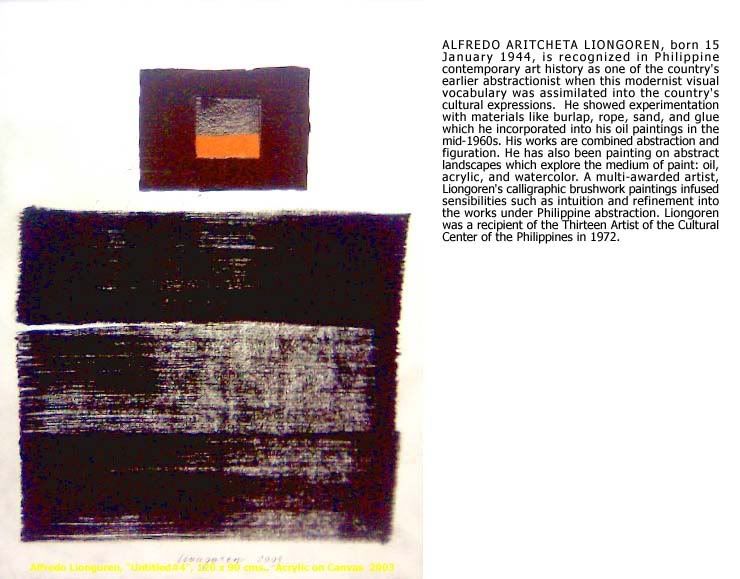
ALFREDO ARITCHETA LIONGOREN, born 15 January 1944, is recognized in Philippine contemporary art history as one of the country's earlier abstractionist when this modernist visual vocabulary was assimilated into the country's cultural expressions. He showed experimentation with materials like burlap, rope, sand, and glue which he incorporated into his oil paintings in the mid-1960s. His works are combined abstraction and figuration. He has also been painting on abstract landscapes which explore the medium of paint: oil, acrylic, and watercolor. A multi-awarded artist, Liongoren's calligraphic brushwork paintings infused sensibilities such as intuition and refinement into the works under Philippine abstraction. Liongoren was a recipient of the Thirteen Artist of the Cultural Center of the Philippines in 1972.


Friday, October 10, 2008

FLASH! RAUL ISIDRO


RAUL ISIDRO was the TOYM (Ten Outstanding Young Men) awardee in 1979 in the field of Fine Arts. Armed with a Bachelor’s degree in Fine Arts (1965) from the University of Santo Tomas, Isidro joined the faculty of the Philippine Women's University wherein he taught for nine years, and was appointed the director of Fine Arts in 1975. He was a former president of the Art Association of the Philippines. During his decade-long stay in Hay ward (east of San Francisco), California, Isidro was the only Asian member of the Hay ward Arts Council.

After decades in the art scene, Isidro’s audience remains guaranteed of his unswerving dedication to abstraction. A calm, rhythmical coherence invigorates his works- Isidro makes certain that he never overloaded the image. And in the expanse of his art practice, Isidro is much too inexhaustible an artist to arrive at a turning point. By no means looking back, he pursues His own route.


A BROWN MAN'S SHADOW ALLEGORY PROJECT


Don Salubayba’s solo show, A Brown Man’s Shadow Allegory Project, developed at his artist’s residency at the Fukuoka Asian Art Museum in Japan, opens at Tin-aw Art Gallery in Makati at 6pm on Friday, October 10, 2008. The exhibit explores the role of myths and folklores in Philippine society and how they have shaped its culture and eras. The show presents Salubayba’s paintings along with virtual, projected images to create shadow installations.

For inquiries about A Brown Man's Shadow Allegory Project please contact Tin-aw Art Gallery at the Upper Ground Floor, Somerset Olympia Building, Makati Avenue , Makati City.

Contact 8927522 or email info@tin-aw.com. Website www.tin-aw.com. Admission is free.

Thursday, October 9, 2008

FLASH! JAVY VILLACIN

JAVY VILLICIN (Jose Villacin Jr.) graduated with a Bachelor of Fine Arts degree major in painting at the University of the Philippines Diliman in 1980 and was a British Council, Byam Shaw School of Art, London fellowship grantee in 1988. Currently, Villacin holds a professorial chair at the fine arts program of the University of the Philippines in Cebu City.

For a time Villacin was in hibernation in his craving to achieve the “shambala” (an advanced plane of awareness and spirituality.) Never losing his state of consciousness, Villacin came out triumphant and rejuvenated from his astral wanderings. His canvasses continue to exhibit impressions and expressions from his foray into the dream world; composite, organic, anthropomorphic or vegetal forms.

But the basic elements of a Villacin artwork are the drawings. There are these usual pencil backgrounds which are far from being the fine or final cleaned up drawings that rejoice the diffidence, the bravado even, in some cases, the pandemonium of drawing. Together with drawing, Villacin also utilizes the array of techniques possible with his favorite medium; acrylic. Of these, layering is the most perceptible. This provides the spatial and, even, tonal texture to the works.

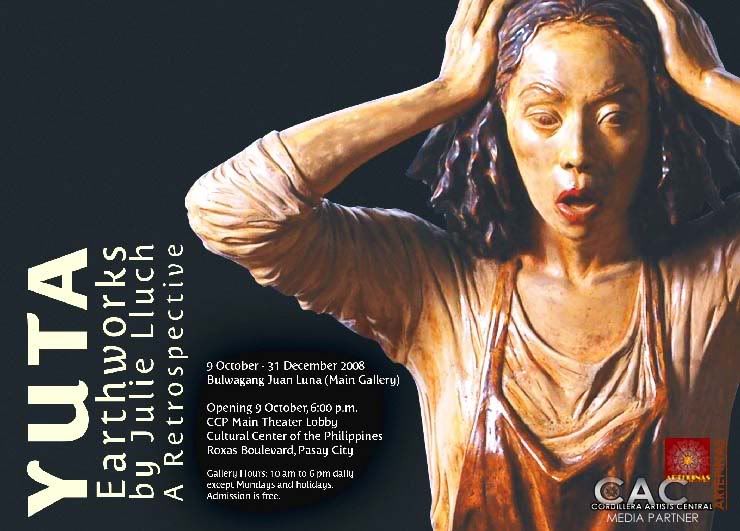
YUTA : EARTHWORKS BY JULIE LLUCH, A RETROSPECTIVE


YUTA : EARTHWORKS BY JULIE LLUCH, A RETROSPECTIVE
October – December 2008

Yuta: Earthworks by Julie Lluch, an initiative of the Cultural Center of the Philippines and Galleria Duemila, celebrates sculptor Julie Lluch's artistic career spanning thirty years. Yuta is a Visayan word for clay. The exhibit will bring together works from private and institutional collections as well as those from the artist's personal collection.

One of the country's foremost exponents of terracotta sculpture, Julie Lluch finds perfect expression in the indigenous clay, which she refers to as the most sensuous and pleasurable medium. A philosophy graduate of the University of Sto. Tomas, Lluch's strong feminist stance helped open the national women's movement in the area of arts and culture and co-founded women's groups such Katipunan ng Kababaihan para sa Kalayaan (KALAYAAN) and KASIBULAN, which she co-founded in 1990. Her works such as Philippine Gothic, Cutting Onions Always Makes Me Cry, Still Life with Cezanne's Apple's on Kiri's 6th Birthday and Picasso y Yo, all raise concern about women's roles in society. Her works also pay homage to stalwarts of Western Modern Art, as well as Filipino literary artists and art patrons. Her life-size figures - Filipina 1898 and Maranao Women—uphold the role of women in the revolution, whether in the past or at present. Lluch also did monuments in bronze of Gen. Carlos P. Romulo, Arsenio Lacson, Chief Justice Jose Abad Santos, Cayetano Arellano and Pres. Manuel Quezon.

Julie Lluch has joined prestigious exhibitions abroad at the First Asia-Pacific Triennial in Brisbane, Australia; the Third Asian Art Show in Fukuoka, Japan; Asian Modernism in Indonesia, Malaysia, and Tokyo; Clay and Fire International Clay Sculpture Exhibition in Korea and Federation of Asian and Latin American Countries show in Manila.

For her excellent works in the field of Philippine sculpture, Lluch was awarded the CCP Thirteen Artists Award (1990), Iligan City's Outstanding Citizenship in Art (1992); Quezon City's Most Outstanding Woman Artist (1995), and the Sining at Kalinangan Award given by the City of Manila (1997).

Yuta is supported by the National Commission for Culture and the Arts, Asian Tigers Lane Moving and Storage, Autozentrum BMW, Epson, St. Paul's de Chartres, Carlos P. Romulo Foundation, Bench, BPI Asset Management and Baileys.

Gallery hours are from 10 am to 6 pm daily except Mondays and holidays. For more information, please call the CCP Visual Arts and Museo Division at 8321125, local 1504/1505 or visit http://viewovermyga te.blogspot.com/

BOSES

BOSES

IBALONG

IBALONG

THY WOMB

THY WOMB


PHILIPPINE ART PUBLICATIONS


About This Blog


SECRET FRESH GALLERY

SECRET FRESH GALLERY

DRAWING ROOM

DRAWING ROOM

ALTRO MONDO

ALTRO MONDO

SINDO ARTWALL

SINDO ARTWALL

OARHOUSE

OARHOUSE

AYALA MUSEUM

AYALA MUSEUM

BLANC

BLANC

GSIS MUSEO NG SINING

GSIS MUSEO NG SINING

MUSEO DE LIPA

MUSEO DE LIPA

NAGA CITY ART GALLERY

NAGA CITY ART GALLERY

GALLERIA NICOLAS

GALLERIA NICOLAS

WEST GALLERY

WEST GALLERY

GALLERY ORANGE

GALLERY ORANGE

40TH LIKHANG SINING 2013

40TH LIKHANG SINING 2013

ART FAIR PHILIPPINES 2013

ART FAIR PHILIPPINES 2013

RIZAL ARTS FESTIVAL 2013

RIZAL ARTS FESTIVAL 2013

CINEMA REHIYON 2013

CINEMA REHIYON 2013

VIVA-EXCON LOGO DESIGN COMPETITION

VIVA-EXCON LOGO DESIGN COMPETITION

2013 AMELIA LAPEÑA BONIFACIO LITERARY CONTEST

2013 AMELIA LAPEÑA BONIFACIO LITERARY CONTEST

ANIMAHENASYON 2013 POSTER DESIGN CONTEST

ANIMAHENASYON 2013 POSTER DESIGN CONTEST


  © Blogger template Brownium by Ourblogtemplates.com 2009

Back to TOP