Tuesday, May 1, 2012
CHAMELEON’S CONVENTION
Wednesday, April 25, 2012
TATAK
Thursday, April 12, 2012
NAKED TRUTH

Sunday, March 11, 2012
GESTURAL REFLECTIONS

Gestural Reflections
Proceso Gelladuga
Galerie Anna, The Artwalk, 4th Level, Megamall-A
Mandaluyong City
The exhibit is open from March 12 to 24, 2012. For inquiries, please contact us at (+632) 470-2511 or send us an email at galerie.anna@yahoo.com. Like us on Facebook: http://www.facebook.com/galerieanna or visit our website at www.galerieanna.com .
Wednesday, November 16, 2011
Saturday, October 8, 2011
INTERVENTIONS

Ensnared in a Web of Gazing
by Reuben Ramas Cañete, PhD
Manichean is the world Grandier Gil Bella sees: the complexities of human existence, relationships, fate, and life’s decisions are reduced into the black-and-white starkness of choice or circumstance that assigns its requisite moral value as “good” or “evil,” depending on how the outcome affects one’s felt interests. Then again, it may also be Grandier’s realization that perhaps it is a human fantasy of wishing that there is a choice in the first place, when in fact stark reality is the only eventuality that stares back at one’s face. This dichotomy of destiny, of the cold statistical tumble of either-or, is what rationalizes and animates Grandier’s use of split complementary or monochrome color schemes in his canvases. The assignment of warm (red-orange) versus cool (blue) tones follows this dichotomic logic by bathing his human subjects and illusionistic textures with a felt polarity: negative and positive emotions and energies are directed and literally illuminated, making the task of comprehension simpler and more meaningful.
It is the search for balance and harmony within this polarized universe that Grandier thus privileges, one that is instantly observable in his compositions, with their mirror-effect of warm-versus-cool or black-versus-white symmetries. Codified into strips of illusionistically-painted paper (a leitmotif that Grandier locates within his own artistic biography), the human subject that is bathed in this dual light illustrates the ambivalence that results in our search for happiness: the intricate lace of half-truths, little white lies, and doubletalk that people inflict upon one another as they progress in a relationship, from a sweet crush, to getting-to-know-you, I’m-so-in-you, and then to what-was-that-all-about and that’s-a-new-side-of-you-I’ve-never-seen; eventually to let’s-cool-off-for-awhile, and finally I-don’t-love-you-anymore. Popular culture has gifted us with a hybrid term for such ambivalent relationships: the frenemy. The simultaneous complexity of social life versus the simpler impact of its effects upon the psyche is what Grandier exploits as he fragments the picture plane into scraps of torn and crumpled paper, re-assembled illusionistically into the canvas like an old, salvaged love letter full of regrets. The human subject is seen animating the spaces in between, and in some cases is caught within, this simulated pastiche of delicate paper and fraught emotion, like an avatar that gives cognizance to the violence that is wrought in the search for redemption.
This melancholic and yet cathartic reflection is given a more direct bearing in Grandier’s current set of works, which alternates between depictions of male and female nudes, as well as portrait studies that capture the internal duality of duplicitous characters as a veritable recreation of the psychotic double, as seen in the film Face Off, or if you prefer the more gentle world of Mike Myer’s Mini Me. The use of gold or silver masks for the female nude, as seen in Ensnared, The Offering, and To What End hint at a private game played dangerously by a lover using emotions like lust, submission, domination, and betrayal. The use of chains, alternating with roses that stretch taught, flail or hang limpidly in the contrasting light exemplifies these bonds to the heart and mind as both sadomasochistic as well as cheekily romantic. Also, the metaphor of the mask as hiding one’s real identity while giving the impression of another character magnifies the duplicity of human character, and implicates the act of gazing as the true source of human despondence and illusory desire, for one often chooses to see the farce of a surface character rather than come to terms with the real person behind the mask.
This anaphora between fake and real, mask and face, external versus internal, and chains versus roses shows Grandier Gil Bella’s mastery of reflecting on the compounded ambivalence of human nature through the act of gazing. Gazes Forbidden wraps up these contrasts with a sharp-edged depiction of the masked lady versus the blurred image of the real person behind the mask, and unites the contrast-coloured world of Grandier with the gaze-focused reality of the human subject as a parallel text. What we decide to do, or to accept as real in our daily lives ultimately revolves around the ability to see past the casual illusions, and focus on realizing the trap of seeing without knowing as the choice that we should deny.
INTERVENTIONS by Grandier Bella opens October 10, Monday, 6-9pm and runs until October 24, 2011. The show is curated by Reuben Ramas Cañete, PhD and exhibition design is by Eghai Roxas. For inquiries, contact Galerie Anna at The Artwalk, SM Megamall A, Mandaluyong City, 470-2511, 470-9869, 0918-9918031, or galerie.anna@yahoo.com. Gallery hours are 10am-9pm daily. For further information, visit: www.galerieanna.com, www.facebook.com/galerieanna, wwwgrandierbella.net.
Monday, September 26, 2011
Tuesday, June 7, 2011
CONFIGURATION

July 8-24
Galerie Anna
Artwalk SM Megamall
10 Participating Artists:
Benjie Cabangis
Noell EL Farol
Fitz Herrera
Rico Lascano
Poch Naval
Jonathan Olazo
Resty Tica
Yasmin Almonte
Mervy Pueblo
Jemina Reyes
Approximating components of equivalence and decidability form a central role in the language of abstraction, ‘Configurations’ operates in mapping fixpoints attributes that exploit the ideas of composed, refined, compressed and decomposed. Led by stalwart in Philippine abstractions, Benjie Cabangis and other contemporary artists like Jonathan Olazo, a consistent award winning painter-printmaker, their works gives new hints and leads to different notions of domains that abstractions does, strongly normalizing parametric relationship in search for corresponding notions of equivalence as part of their definitions and reasoning.
Joining are works by noted and respected young contemporary artists, the bold abstractions by Fitz Herrera and Resty Tica. Herrera's works play on rigidity as well as fluidity - rebellious lines that contain, and solid colors that rub off into nebulous wholes while Tica merges the veritable signifier of abstraction and graphic starkness of design. While Rico Lascano and Poch Naval’s minimalist's works operate in configured components of abstractions complements the equivalence of the concept of the show. Sculptor Noell EL Farol works in slab form features the act of making as a process of decay eliciting a 'contemporary' archaeology.
Complementing the show are works by female contemporary abstract painters, Yasmin Almonte, Mervy Pueblo and Jemina Reyes.
Yasmin Almonte continue to employ wide range of painterly techniques to create a field of suction, complements her manipulation of visual cognition within her paintings. Working towards sublime fields of painterly abstraction, rendered with alternate areas of thick impasto while wielding artistic process as a mode of investigation is seen from the works of sculptor-Painter Mervy Pueblo. While Reyes' paintings possess an imposing elegance, densely translucent layers and visceral distance.
Thursday, December 9, 2010
HOMAGE TO THE END OF THE EQUINOX

HOMAGE TO THE END OF THE EQUINOX
Latest Paintings by Mideo M Cruz
Gallerie Anna, 4th Floor, SM Megamall A, Mandaluyong City Philippines
Opening reception on December 1, On view until December 15, 2010
DESTRUCTION OF THE SACRED by Dave Lock
Apart from his well known shock-performances concerned with fake gushing blood, viscerals, and other familiar mutations of revered Gods and Goddesses, Mideo M Cruz also considers painting as another chief art form. And on his most recent display of works, he has basically chosen to spend months on the confines of his studio, working in a painstaking involvement of detail to finish the pieces that he has prepared for this exhibition. This further reinvents his exciting, intellectual imageries into something that is orderly fixed on a gallery wall, like a memory coarsely nailed inches deep into the head of it's viewer.
Despite the extensive difference in medium, the artist was able to retain his incorporation of organic entrails and his love for detail through the embodiment of repetitive patterns embedded as the background of his works. It's also quite noticeable that the artist has used the imageries of varied animals that are usually worshiped and regarded as divine by different religions and cults, such as the tiger and the elephant. Of course he has included the most respected and exalted of them all, in terms of both time and numbers, which is the fish. Ichthys, or more known as ichthus can be read as an acrostic, a word formed from the first letters of several words. It compiles to "Jesus Christ, God's son, Savior" in ancient Greek. From the strong controversy of this matter, audiences may definitely be not surprised because through the years of his steadfast career as an artist, Mideo has already been strongly associated with presentations regarding the paradox of religion, and eventually leading to the questioning of its major role in the brainwashed, metaphysical construction of society itself.
With regards to visual aesthetics, the artist has depicted the mood in a manner that creates a certain atmosphere of Asian art, because compared to westerners, Asians are more inclined and are possessed with the natural tendency to pledge loyalty to gods, whereas what their foreign counterparts would only consider as pieces of literature and mythology. This strong Asian feel, associated with ornamental patterns, creates the perfect aura for the paintings to sound more fit to what the artist wants to present. The parallelism of figures is also very noticeable, with the other side showing the internals of the chosen animal the artist wants to represent. This somehow creates an illusion of separation and disassemblement, as if the mass of flesh was sliced into two halves, with one side showing what it looks like on the outside and the other, inside. This can also imply them of being stripped off their sanctified qualities, turning them into mere, fleshly constructs, something that what they really are supposed to be.
An equinox occurs twice a year, when the tilt of the Earth's axis is inclined neither away from nor towards the Sun, the center of the Sun being in the same plane as the Earth's equator. The term equinox can also be used in a broader sense, meaning the date when such a passage happens. So basically, this may symbolically refer to a transitory period, a time when a huge, valuable amount of change is bound to happen. And since the age of the fish is fast approaching for the second time (the first being Christ's birth from a human mother), this may be interpreted by some as another apocalyptic warning of our own impending doom, the end of the world, or perhaps just a brief cycle of change, playing a central role in man's evolution and existence as an individual. This, according to the artist, is left to the audience's perception and personal judgment.
This is a homage to the end of the equinox.
Tuesday, August 24, 2010
Thursday, July 29, 2010
DIGRESSIONS

An art exhibit featuring the latest artworks of
Allan Alcantara
Aaron Bautista
Carlos Totong Francisco II
Isidro Jon Santos
Saturday, July 31, 2010 at 6:30pm
Galerie Anna, 4/L, Artwalk Bldg. SM Megamall
Mandaluyong City 1605 Philippines
Will run until Sunday, August 15, 2010
In this show, four artists from Angono probes into the concept of straying away from the normative constraints of society and culture itself. “Digressions” is all about setting foot on a different path, and eventually giving birth to a new shape of perspective in thought. According to the artists, this concept of exploration and enlightenment is very essential to oneís development because without it, we remain fixed into a repetitive system of beliefs and further denies the existence of growth and philosophical maturity inside oneself. Our country, for example, has always been known for a traditional and conservative nature with regards to viewing everything, including art. Years of colonization had brought us superstitions, conventionality in clothing, especially for the women, religion, and even art itself. This is what the new breed of new Angono artists are trying to break, or perhaps penetrate, setting a hole which leads toward what is beyond. “We only want to make a statement on how we view the concept of art-making in a new perspective, retaining its familiar picture, but offering a new standpoint on how things should be understood and perceived” one of the painters explain. For all we know it, art has been invaded by formulas, a system of sellable styles, and even an outlook on how beauty and repulsiveness is judged and separated from each other. There are times when paintings are being measured by their decorative value as an architectural piece of design, or maybe restricted to mediums which should be used and employed. However, these are but rules set by man, and therefore, can also be broken by man himself. This is what the artists trying to breach, and through their own art, present a new angle on the presentation of such things. Itís all about testing the limits of something and breaking it repetitively, until it eventually shatters into an infinite form of pictured possibilities. And from these possibilities another set of standards would be born, which we must in time break into infinity again. It just simply proves that the metaphysics of evolution itself is strongly inspired by failure, experimentation, and straying away from what has been. The cycle goes on into an expanding circle until man reaches the end, or if there is an end.
Wednesday, June 9, 2010
MGA LANGGAM SA BAGUIO

Distorting Some More on a Cooler Place
As it is now, as it was evident then, the 1906 plan of American architect and urban planner Daniel Burnham (who also did the plan for Manila after designing Washington DC in 1902 before San Francisco in 1907 and Chicago in 1909) for Baguio did not fully materialize because there was just too many people increasingly occupying the city. For whatever their reasons may be, personal or economic, historical figures would show that from having 489 residents in 1903, it ballooned to 30,000 in 1948. To date, Baguio’s population is easy 300,000.
More than just the statistics, unmindful of the city’s centennial year, Ambagan’s creative task was to spend an early summer there and capture the images of the city for his second solo exhibition, Mga Langgam Sa Baguio. A collective body of 26 works of various sizes with the biggest at 3 x 8 ft and mostly 3 x 4 ft resulted from this endeavor.
Continuing his signature style of distorting realism as a imaginative manner of justifying a particular approach to life for a multitude of assemblies, for Ambagan, it is the place and not the throng that dictates such phenomena like Quiapo, Monumento, Kapasigan, and this time Baguio. (named after the indigenous plant bagiw)
“More than the numbers” as he would put it, “by physically rubbing elbows and sweating it out with them, I could feel their pulse which is very significant if you are serious with the context of your craft.” Quite close to his heart, Ambagan has always been fascinated with Baguio and its Cordillera culture: “I have always gone back and painted Baguio and its nearby communities like Sagada and Mayuyao on my mind. It is the nearest place you could go and be in touch with our pre-colonial soul. It keeps me grounded.”
Baguio’s Oil
Typical of an artist bred by his milieu, the influence is obvious. All his life Ambagan has been living in crowded places -- he grew up in a compound with an extended family of relatives; he has lived in Pasig -- one of the most densely populated cities in the metropolis; he has studied at the largest high school in the world. Even this show is exhibited at the heart of one of the most crowded public places you could find.
Like an obsessed chronicler of his time, Ambagan frequents to wherever multitude of people gathers. He has gone to Quiapo, Pasig, and various places sometimes aboard the Metro Railway Transit (MRT) for a different perspective. Meticulously documenting the amassing of assemblies, he follows where they are and why or how they are there. He wanted to grasp the “interplay” of the real and symbolic in their desperate yet dignified lives.
For Ambagan, there is more tension in Baguio than most of the places down here. Giving more texture in the pieces paving them with a more rustic finish, Ambagan does not want you to be a passive viewer. In Higante 2, from where you are standing in the gallery, the painting unsettles you, as the strong current of paints perturbs the jeep just by the mere viewing of it.
“Distortion really depends on how I see the image I chose. Minsan sa pagpinta na doon ko na dinedesisyunan. Kaya may degrees ang distortion, Nakabatay sa eksena.” This premise is evident in the works Humahangos 2, Kalaro, and Hikayat.
However in the biggest masterpiece Angkas, notice that there is not as much distortion but you could still deem as the surface of the canvas as it grabs you for its sheer immensity and muddy surface.
Conscious of how he paints, Ambagan wants his pieces thick, dirty and rough as seen in Wen Manang, May Pag-asa, and Suke 2 where his sense of perspective pervades. At close range one can observe only extreme layers of paints on top of each other however as the viewer steps back, one sees “the forest from the trees,” a better and grander view greets you. Ambagan feels that his canvas is not finished unless he fills it up with texture, so a simple bicycle scene on a Sunday morning could be embedded with hostility as well.
All is not dark and grim with Ambagan who may have been affected by the cool climate of Baguio this time. In fact in this show he introduces one light source in most of the pieces as a way of paying homage to Philippine old masters like Fernando Amorsolo and Fabian dela Rosa. In Suke, Pagbabalik, Pila, and Dagsa ever the sentimentalist that he is, he rediscovers the Philippine sun. Our painting must be created outside the as western mold for us to claim it as our own and it was Amorsolo who set the rules in his/our own terms.
“I have been to other countries, iba talaga yung araw natin lalo na tuwing umaga. Dito lang yan. My use of the sun is like honoring these giants of Philippine art. The brilliance of the colors of nature is more intense most especially in the morning,” he adds.
Except for one afternoon scene, you have to note that all the works have the same time of day, as Ambagan captured them somewhere in between 8 to 10 in the morning. With the lay of black and blue, notice how the shadows in Humahangos, Silong, and Tanaw had become violet when reflected as shades from their varied tints. For this he had the impressionists in mind particularly Claude Monet who made a dent in his artistry.
True to his purpose, Ambagan’s work uplifts and documents the secret lives of our common folk: the vegetable vendors in the sidewalks, whom you can’t even get a discount if you do not speak the international language of Ilocano; the guys who rent out bicycles for P100 per hour so you could roam around Burnham park. They all come vividly alive in Ambagan’s canvases.
As in his first show, an obvious favorite and consistent representation in Ambagan’s pieces are jeepneys. In Baguio, they are bigger and more functional – the wheels, the passenger seats and even the special ladder that makes you climb and enjoy the double-decker seat, dust-free. Although in Baguio they are even more stoic in color and very accommodating with the minimum sitting capacity of 20 passengers. In Hango, Humahangos, and Pila, these Manila-bound sturdy vehicles can’t become complacent. They have to make the goods on time in their respective destinations for distribution. The jeeps must deliver the produce, as if their lives are dependent on them. As fast as they are packing their vegetables Ambagan has to swiftly paint them to capture the moment, or else the produce will be stale or rot, either the vegetables or Ambagan’s artwork will. There are also four checkpoints (of course there is a fee for every pass) to contend with that they have to hurdle on their way to that destined bagsakan in Manila. If they get delayed further, they miss the weekend rush of the people to the market. There goes everything – puhunan and tubo. In this lovely city of pines known for its ukay-ukay or cheap bargain finds, are their dreams included in that as well?
To complete his iconography, Ambagan is also an advocate of those Philippine icons slowly vanishing by the rummages of time like that ice cream vendor with his folk art cart. Again in Silong, Suke, and Angkas, we see mamang sorbetero patiently waiting in the scorching heat, amidst the backdrop of a carefree public who are continuously walking and passing him by, unmindful of his presence.
Ambagan may have depicted simple themes, very familiar subject matters in the local genre but not in a typical, commercial kind of way. An in-your-face realist, Ambagan’s sense of proportion is clockwork training marked by years of mural making and painting walls that adorn resorts and interior walls of restaurants. He has an eye for what makes a well-balanced significant feature.
Special note is Tanaw 2, a afternoon scene unconsciously showing Ambagan’s romantic side. We have known his works to be intense, harsh and determined but the softness of his lights in this work reflects an uncanny mushy side of his being.
Back to his patriotism, Ambagan likes to paint his inspirational idols on t-shirt making it a canvas within a bigger canvas. A statement within a statement we see Jesus Christ and Jose Rizal in Buena Mano, May-Pagasa, and Harinawa.
Session Road to Distortion
Ambagan’s loosely and broadly-handled color palette creates a sense of immediacy which reflects the contemporariness and active stance of his subjects. Looking at the pieces, Ambagan seems like a badly-behaved poet, one who knows all the right corners and when to make that left turn. Knowing all the thugs, the goons and the whores of the city, he is well-versed with the saints and sinners in the streets.
There is more to just focusing on light, people, and action that go with his painting pretty pictures than meets the eye. As he scouts the place of choice, armed with a digital camera, he is like an expedition explorer surveying the land while selecting a scene for that framed shot. Composition is one of Ambagan’s forceful points. You would think that his spontaneity is mere spur of the moment but he is very scrutinizing with his subjects, close to scientific in his approach to his medium. There is the long and arduous process in composing some more in the computer to suit his preferred distortion.
The actual painting proper is a three layered procedure -- base strokes, lightness, pattern or the distortion part. Different layers require different brushstrokes. I have seen him use at least ten different brushes in one of his sessions. Showing his meticulous self, only Ambagan knows when the artwork is appropriately done or if it he still needs ample time to add more details or finishing touches to them.
Starting from a white primed canvas fabric with grounds like gesso and chalk. The absorption of the colors is dependent on how much the canvas is primed on its materiality. Second layer uses the grays and other subsequent colors for the eventual wet-on-wet or wet-on-dry technique (alla prima technique). Marked by Ambagan’s unconventional process, by this time, coats of the colors become indistinguishable. Opting for a natural mat finish, Ambagan has to unlearn academic rules saying he should varnish but Ambagan constantly rebels.
His art is fleeting in this lively fluid sketchy technique. You might find him conservative in this aspect as Ambagan’s method somewhat like the style of the impressionists, but it is slow and laborious. Each layer had to be dried before he touches them again. Even more confident this time around, the signature distortion is there but his brushstrokes are thicker. This will give you an idea how long it took him to prepare for this show.
“Distortion is about change in approach in art in my desire to something positive. However distortion is more than technique, the more gravity, the deeper the meaning there will be. Also I don’t like repeating a painting I have already done. Distortion gives me the freedom to say something again in another manner,” explains Ambagan.
Baguio’s Boulevard of Broken Dreams
Ambagan has celebrated Baguio in a way that he knows -- with traffic, wires, filth and all. It may not be ideal to some but it the Baguio nonetheless that he saw at a particular point in time. An aesthetically assertive painter, for Ambagan art is about dialogue. Being one of and with them, the proximity of his imagery on canvas is as if you are next to the crowd he paints. There is a merging of the spectator as we (viewers in the gallery) are part of the spill of people from the artworks. Distinct lines have been blurred, as the characters are all one with the audience as Ambagan is part of the stories he wants to tell.
This show is a visual witness without the intervention of the intellect or part of an ongoing Department of Tourism campaign. There is a semblance of hope, as seen in the blueness of his skies on the canvases. “You just have to keep your eyes open and let their daily struggle inspire you. So in my being inspired you are inspired. Kahit matao, maganda pa rin ang Pilipinas. If I can make you imagine it, then it was worthwhile painting them,” Ambagan ends with a sigh of relief.
Thursday, April 22, 2010
SIGNOS: SIGNS, STREAMS AND SIGNALS

These are weeks that bring us on the brink of change. Whether this transition translates into transformation is hardly the question anymore. Elections are deemed as another exercise in a conflux of signs and signifiers, wherein we gesture a functional democracy through a process of campaigns, equal opportunity and symbols of the individual’s power to decide. It is both a gamble and a game: to take hold of these names, numbers and be able to place them in positions and domains.
SIGNOS signifies portents and omens: images and manifestations of what is to come. What could take place as one may imagine or wish for through symbols of specific constructs. On the brink of passage, or afloat in stasis, these are signs that could just be telling us what to think, what to do, and where to go.
Galerie Anna co-presents with slash/art artists’ initiatives the group exhibit “SIGNOS: Signs, Streams and Signals” featuring new works in various media by Con Cabrera, Buen Calubayan, Joey Cobcobo, Marika B. Constantino, Don Djerassi Dalmacio, Karen Ocampo Flores, Lotsu Manes, Emil Mercado, J Pacena II, Mervin Pimentel, Christina Quisumbing Ramilo, Iggy Rodriguez, Kirby Roxas, Don M. Salubayba, Mark Salvatus, Art Sanchez, Mimi Tecson, Teta Tulay, Wesley Valenzuela and Kalye Collective (Dennis Atienza, Robert Besana, Alvin Cristobal, Alfredo Esquillo, Kirby Roxas and Archie Ruga). SIGNOS also features live art performances by Jef Carnay, Kaye O’ Yek and Jepren Solis on its opening night.
The exhibit opens at the Megamall Art Center on April 23, 2010 at 6:00pm and will be on view daily mall hours until May 9, 2010.
For particulars, contact Galerie Anna at 632.4702511 / 632.5679483.
Email galerieanna.events@yahoo.com or visit www.galerieanna.com
Wednesday, December 9, 2009
ISKWALADO II

On a physical level, Iskwalado means flatness of the surface one’s canvas appropriately paints on. For the sensitive artist, it will be extremely difficult to proceed with the painting process unless this proper alignment is settled. Thus, Iskwalado refers to that sense of proportion that commands an image one perceives a subject matter hanged on a wall space.
A deeper understanding of Iskwalado may also connote a sort of perfection, short of having done a beautiful artwork, an excellent consummation that accompanies a significant work considered by artists.
Selected for their fresh and original approach to art-making, 40 artists were given 24 x 24 inch canvases to paint on. Encompassing three generations of creativity, Iskwalado II presents a new way of looking at group shows, not linear or thematic, regardless of art movements, schools of art, visions or painting techniques, As the Galerie Anna’s commitment and ongoing pursuit, Iskwalado II may just be a sort of Philippine contemporary art sampler, representations of particular trends or significant styles artists are now pre-occupied with. Iskwalado II defines the art of our time, as it is a celebration of the imaginings of the individual and what it means to be a Filipino artist today.
Participating artists include Gus Albor, Hermes Alegre, Nunelucio Alvarado, Ricky Ambagan, Jojo Austria, Max Balatbat, Malyn Bonayog, Mel Cabriana, Choie, Dansoy Coquilla, Nill Cruz, Joseph de Juras, Abi Dionisio, Ferdinand Doctolero, Neil Doloricon, Roberto Feleo, Dennis Filart, Grandier, Fitz Herrera, Joey Ibay, Louie Ignacio, Jun Impas, Ferdinand Liongoren, Josue Mangrobang Jr., Lex Marcos, Dennis “Sio” Montera, Bobby Nuestro, Tiny Nuyda, Sam Penaso, Jun Rocha, Kirby Roxas, Lirio Salvador, Christian Tamondong, CJ Tanedo, Valen Valero, Olan Ventura, and Orley Ypon.
Monday, November 23, 2009
AMBIGUOUS ICONOGRAPHY
Your Friendly Modern Painters Live Next Door
By Jay Bautista
For art historian Erwin Panofsky, a significant work of art must be able to distinguish as to what the viewer sees or what he termed as appearance from whatever pre-conceived meanings or any second or deeper reading of the image on the art work itself. It is to this basic premise that Vincent Padilla and Grandier have conceptualized their two-man show, Ambiguous Iconography.
Padilla continuous with his obsession with overweight subjects as slobs represents the excessive nature most of us may probably imbibe. In exploring this common culture of overindulgence, Padilla reflects this to us in an in-your-face reminder of what we could possible be. He has remained confident, effective and fun with this distinct style.
There is something in the air of Antipolo that makes artists out of its residents and in Padilla, being the youngest member of the Salingpusa art group, the influences are still evident although he has managed to have his own particular brushstrokes. In Barong Tagaalog and Baro’t Sayang, he places an opaque texture and a very detailed callado-finish of our traditional Philippine attire against the voluptuous body of the bearer. An ambiguity indeed and the contrast and the direct contact of the jusi with the one’s skin send shivers to those who view it. Admittedly, even if you are wearing our national costume it doesn’t guarantee your patriotism. It could just be skin-deep for many have already used, abused, and overused the manner of wearing them with unpatriotic thoughts in mind like corruption, lust, sloth or greediness. Padilla even coined it as “public free service.”
In Laughing Bondat, “slobness” is more than being a glutton or obese, that you may not even be fat but you could be a certified blue slob with how you perceive or are perceived by people. Even in thoughts one can be full of deceit and caprice.
For Grandier, one’s sense of uncertainty may not necessarily equate to ambivalence. As one advances in life, confusion may not necessarily mean indecision on his part. The more man exists the more he is confronted with questions and even more choices. “One cannot ignore the present harsh realities we encounter around us, the burden of living and surviving affects us all. Amidst these circumstances, we are left to ourselves to comprehend and determine our course of action.” Grandier emphasizes.
How Grandier depicted man’s ambiguity in the melancholic piece The Present Scheme proves the point. As fate would have it, as he was preparing for this exhibition, recent events like the victims of typhoon Ondoy got him on another level of anxiety. Like a true artist, one witnesses man’s vulnerability and impermanence of one’s existence as we observe the said work.
With absence of negative images, Grandier relies much on the realism of photography as an approach for his message to come across. In Past Descending, evident in the withdrawn emotions, darker hues and the shadow of concern abound as the hyper-real expressions makes an effort to reflect in a mirror-like manner the many tensions within him. As it connotes, the past are what he perceive as earlier contentions and learning points in one’s life. It could be our degrading environment, useless governance of our public officials, or as basic as the security of one’s family.
After ten years as an art director, like an old true love, he comes back to painting. Noticing the personal and social changes in his career have started to seep in, Grandier is at an emerging phase of his artistry, the show is another way of testing another artistic style or a creative act of questioning.
With crumpled paper representing his meaningful experiences, Grandier comes out hopeful with Future Ascending as the ironic clear depiction and positive gestures of his main representation, as opposed with the other two works. “We have to make sense as to the clutter that surrounds us” Grandier eventually points out.
Padilla and Grandier are the chroniclers of our time and maybe in our neighborhood. By forced circumstance, they do not have much choice but to do what an artist is obligated to do – to paint the dilemma as a continuous struggle for resolution and fulfillment.
Friday, September 18, 2009
Sunday, February 8, 2009
UNANG HAYAG SINING

GALERIE ANNA PRESENTS UNANG HAYAG SINING: EMERGING ARTISTS 2009
To celebrate the National Arts Month of February, Galerie Anna, a world-class service provider of the Philippine and Global Art in the national and international market, proudly presents the exhibition: “Unang Hayag Sining: Emerging Artists 2009,” from February 12 to March 12, 2009. “Unang Hayag Sining” showcases the works of thirty emerging and upcoming young Filipino Artists who have proven their worth in the highly competitive national and international market of art. They provide a fascination cross section of talent and stylistic diversity which characterizes the strength of contemporary Philippine Art.
Wednesday, December 3, 2008
TABLE/TOPS

Table/TOP at Galerie Anna
Galerie Anna, a world-class service provider of Philippine and Global Art in the national and international market, proudly presents for the month of December a major exhibition of recent works by renowned and upcoming Filipino sculptors. Titled “Table/TOP”, the exhibition features the works of members of the Society of Philippine Sculptors (SPS) and other sculptors, such as National Artist for Sculpture Napoleon Abueva, Ral Arrogante, Ferdie Cacnio, Mervy Pueblo, Rogger Basco, Byron Salarza, Jecky Alano, Eghai Roxas, Ronel Roces, Rey Contreras, Tala Contreras, Julie Luch, Juan Sajid Imao, Arnel Borja, Pablo Mahinay, Jojo Sagayno, Uly Veloso, Dan Raralio, Noell El Farol, Evan Bejec, Jerry Araos, Julian Araos, Jenny Cortez, Dion Gonzalez, and Lirio Salvador.
Opening on December 5, 2008, at 5PM, and continuing until January 10, 2009, “Table/TOP” is a compelling journey that provides a tantalizing solution to the perennial problems of making sculpture relevant and significant in these contemporary times. Sculpture in the
Tabletop-sized sculptures, on the other hand, are more conducive to the tangible experience of viewers, who can not only view them at closer range, often at table height (hence the term “table top”); they can also touch and feel their surfaces with greater precision, and time to size up the effect of the sculpture in relation to their users. Tabletops are often derided as “commercial-friendly” because of their portability—and thus their easy disposal. However, we must also remember that the pleasure of handling and moving these small sculptures is precisely part of their appeal among collectors, as well as ordinary people drawn to the intimacy of the scale—and thus greater interaction and understanding results, something that a public statue oftentimes cannot achieve.
“Table/TOP” thus looks at the phenomenon of the small but significant, and locates the force of art not at the table itself, but what is on top of it—the unique creations of three generations of Filipino artists who have inherited the tradition of sculpture from the giants of the 20th Century, as well as centuries of native traditions and modern innovations that have enriched our culture. This includes the expressionistic but humane figurative pieces of Napoleon Veloso Abueva, the first National Artist for Sculpture and former disciple of Conservative great, National Artist Guillermo Tolentino. Abueva’s Modernism, which came of age in the early-mid Fifties, is highly nuanced but elegant, reducing natural elements to gentle curves on hardwood or concrete; or the drama of human action and allegory in his figurative statuary, a Romantic sensibility that he inherited from his master. Then there is the figurative works of those who came of age in the Seventies, like Jerusalino Araos’ sinuous figurative pieces; Julie Lluch’s evocative curvaceous forms; the curvilinear abstracts of former Abueva disciple, and now New York City-based artists Pablo Mahinay; and the socially committed and indigenously-themed social realist works of husband-and-wife sculptors Rey Paz and Tala Isla Contreras.
In the Eighties and early Nineties, the sculptural works of emerging artists shows the heritage gained from the emergence of both abstract as well as figurative traditions in Philippine Modernism—the fusion of the two achieved through the tireless experimentation and courageous open-mindedness of Abueva and fellow National Artist Abdulmari Imao. Ral Arrogante’s subtle and infectiously cute “Scrapologies” made from recycled scrap metal; Eghai Roxas’s abstract boxes and cubes; Dan Raralio’s segues from an almost academic figurism to a totally abstracted minimalism; Noell El Farol’s innovative use of colored and collaged glass; Ulysses “Uly” Veloso’s ironic and psychologically-dense treatises; Arnel Borja’s deftly-executed “balancing” sculptures executed in refined metallic and machine-like forms; and Juan Sajid Imao’s equal emphasis on curvilinear abstraction and human figures were all part of this process of digesting and meditating upon the aesthetic landscape that emerged in the wake of the Filipino Modernist giants.
In the latter Nineties and into the Second Millennium, this process of expanding upon Philippine Sculpture also acknowledges the contributions of those of the regions outside Manila, such as Cavite-based Rogger Basco’s Art Deco-ish figurative minimalism; Cebuano sculptor Evan Bejec’s submlime curvilinear sculptures executed exclusively in hardwood; fellow Cebuano Jojo Sagayno’s recycled-from-the-garbage-bin metal sculptures; and Ilonggo potter Jecky Alano’s ceramic sculptures of rotund human bodies. The younger generation of sculptors has also continued to redefine the tabletop in terms of form and meaning. Lirio Salvador’s ingenious “sound sculptures” are reconfigured to question the solemnity and silences of the household; Mervy Pueblo’s muscular concrete forms encased in steel defy the expectations one assumes about “women’s art”, and Ferdie Cacnio’s brass human figures of dancers exemplify the concern for defying gravity and pushing the boundaries of media to its fullest.
To expand upon the importance of Philippine Sculpture on this exhibition, two major activities will also be held on the duration of this exhibition. On Tuesday, December 9, from 2-5PM, there will be a public discussion on Philippine Sculpture by selected participants of the exhibition. On Tuesday, January 6, 2008, the curator of the exhibition, Dr. Reuben Ramas Cañete, will deliver a lecture on “Philippine Contemporary Sculpture” from 2-4PM. Both events will be held at Galerie Anna. The public is also invited to witness and participate in this event.
Galerie Anna, the presenter of this show, is as much a gallery for young emergent artists as for celebrated artists recognized nationally and internationally. The Gallery aspires towards significant showings of Philippine Art and discerning fresh artistic ideas with a view to making connections with the wider audience. We believe in Art that probes new frontiers, pays homage to individuality, and emulates the diverse ideas and values of society that can be stimulating and enterprising, especially at this juncture when the plurality of its expression in the
For more details and information about “Table/TOP”, please call or contact the Gallery Manager at Tel. # 567-94-83; or email at info@galerieanna.com. You may also click your Web browser at http//:www.galerieanna.com.
Friday, October 17, 2008
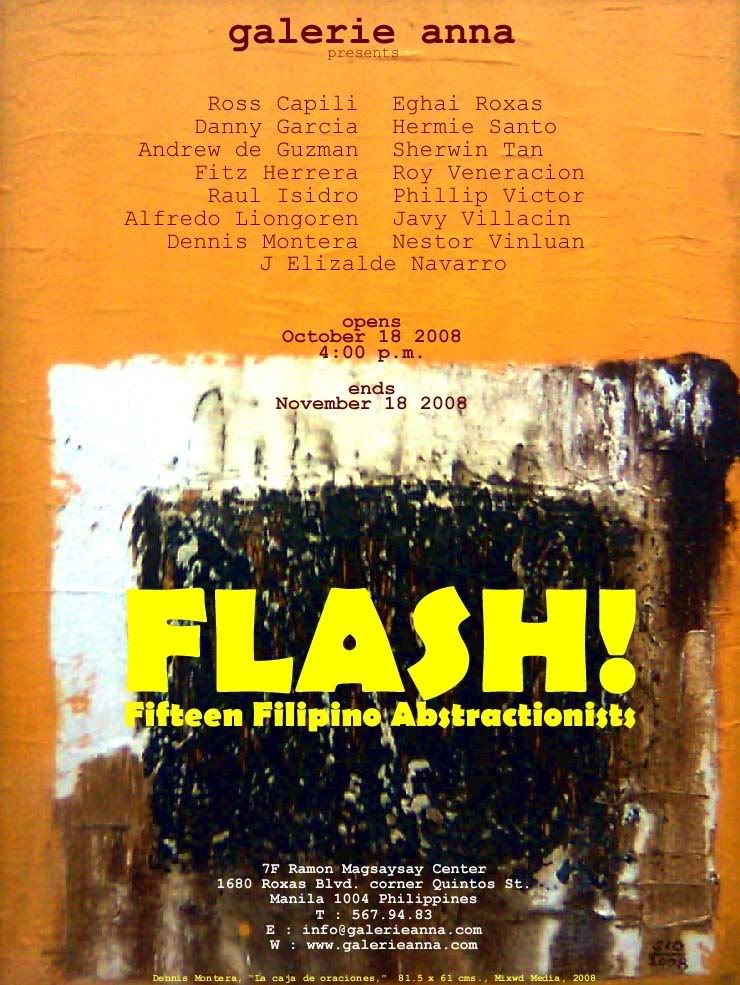
FLASH! FIFTEEN FILIPINO ABSTRACTIONISTS

SOCIETY has been exposed to the creation of abstract art since people have existed, but recognizably, there are varying "levels" of abstraction. Depending on the degree of abstraction, the artist has to discover more ingenious ways of conveying that precise concept. At an instance in humans’ early history, cave walls became the canvasses of men and women who drew scenes of hunting, of their flourishing bounty, of race, moment and milieu. Contemporary painters, such as Jackson Pollock, articulated emotions and pure concepts on canvas. Because his work has been inclined to focus around the notion of order within chaos, Pollock is an eminent paradigm. The perception of victory or success in hunting has to be easier to express than the notion of orderly chaos. With more involved "subjects", the form of expression itself has to become flexible. Thus, the significance of abstract art.
In his essay Roots of Diversity in Philippine Contemporary Art, artist/writer/curator Ronald Hilario noted that “The early 1950's saw the triumph of the modernists over the conservatives. Thanks to the efforts of Lyd Arguilla of the Philippine Art Gallery in showcasing the art of the young modernists, abstraction gained a stronger foothold and soon became the dominant style. More informed in the aesthetics of cubism, surrealism, and expressionism, these young artists expanded the concern of Philippine visual arts from style to a broader exploration of the formal elements of visual art. The first non-representational paintings and sculptures appeared at this stage, and were developed to a higher level by the third wave of artists who came in during the 1960's to the 1970's. Some of the more active artists in this period were Vicente Manansala, Napoleon Abueva, Jose Joya, Cesar Legaspi, Arturo Luz, and Fernando Zobel. Texts on abstract art became more available to artists in the 60's. Modernist art theories were introduced and taught in the Philippine Fine Arts Schools by academics and artists such as Rod Paras Perez and Roberto Chabet. Readings of these texts paved the way for a more cerebral approach to art making. Conceptual Art, Minimalism, and Performance Art made their debut in the country. Artists also became more vocal about their works and some published their ideas in art journals such the Philippine Supplement in the 70's. The Marcos regime's patronage of the arts added muscle to many artists' projects. The Cultural Center of the Philippines (CCP), the centerpiece of the First Lady Imelda Marcos' cultural program, was established and became the home of non-objective art. During the tenure of artist-curators Ray Albano and Roberto Chabet the CCP galleries were sites of numerous abstract art exhibitions and performances. At the forefront of these activities were Ray Albano, Gus Albor, Roberto Chabet, Mars Galang, Ben Maramag, Lee Aguinaldo and David Medalla.”
Modern art has usually been characterized by its inventiveness, and within this parameter, critics have looked to formal innovation to classify artworks in relation to their time, rather than place of origin. The nonrepresentational contemporary art that critics have made canonical was concerned with universal and transcendent aims, or with rendering concepts.
The title implies urgency, not the haphazard approach for art’s sake, but of the manner by which the artwork impacts on the viewer. It is the resultant realization when the message of the abstraction has been deciphered, and in this instant, that dawning comes charging fifteen times over. That ensuing speed, that consequential rush impinging on the cerebral, in a flash engulfs the aficionado.
This exhibition features drawings, paintings and sculptures – significant pieces designed to visually expound important concepts about abstraction and its history in a non-threatening manner copulated with the dynamic relationship between discourses, forms, and styles. From the deceased to the emergent, the artists in this exhibition were all vital to producing the FLASH, a uniquely positioned showcase of Philippine Abstraction.
Ross Capili, Danilo Garcia, Andrew de Guzman, Fitz Herrera, Raul Isidro, Alfredo Liongoren, Sio Montera, J Elizalde Navarro, Eghai Roxas, Hermi Santo, Sherwin Tan, Roy Veneracion, Phililip Victor, Javy Villacin and Nestor Olarte Vinluan.
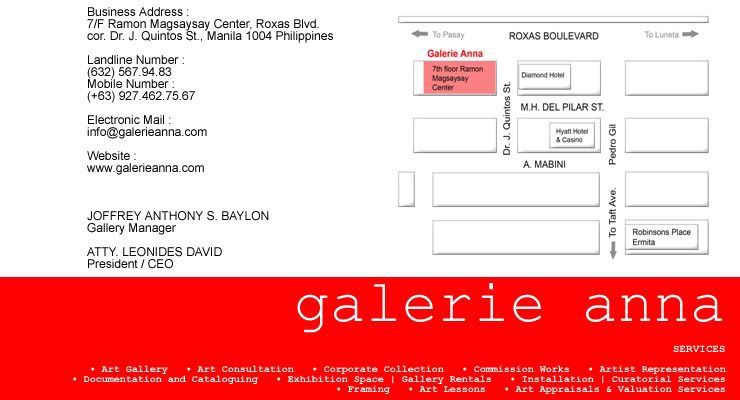
FLASH! Fifteen Filipino Abstractionists shall be on view starting October 18, 2008 at Galerie Anna, 7th floor, Ramon Magsaysay Center, Roxas Boulevard corner Dr. J. Quintos Street, Manila 1004 Philippines. For more information and queries about the gallery and the exhibition, you can log on to www.galerieanna.com, contact Gallery Manager Mr. Joffrey Baylon at landline number (632) 5679483, or email at info@galerieanna.com.
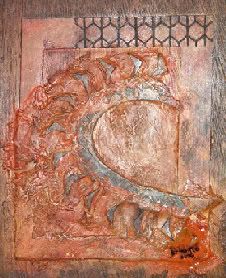
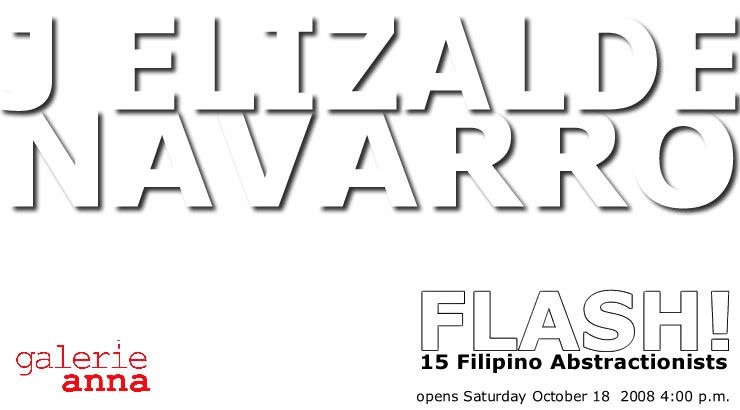
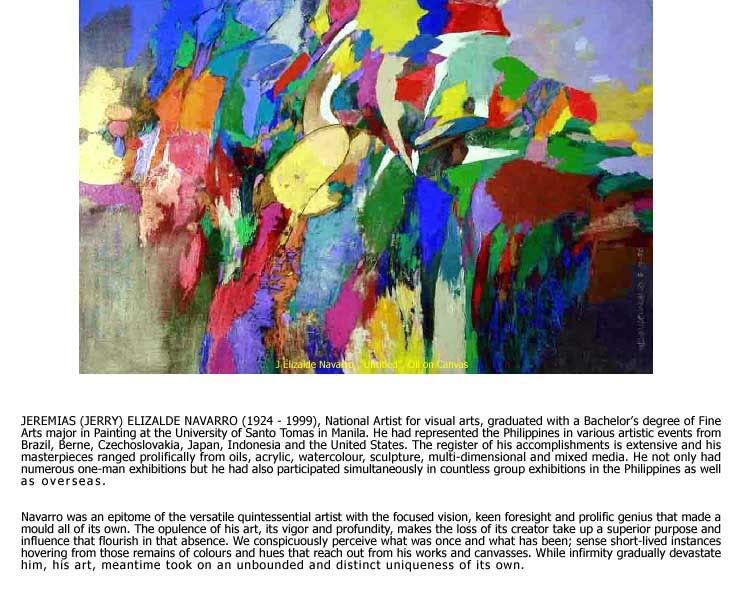
FLASH! J ELIZALDE NAVARRO

Navarro was an epitome of the versatile quintessential artist with the focused vision, keen foresight and prolific genius that made a mould all of its own. The opulence of his art, its vigor and profundity, makes the loss of its creator take up a superior purpose and influence that flourish in that absence. We conspicuously perceive what was once and what has been; sense short-lived instances hovering from those remains of colours and hues that reach out from his works and canvasses. While infirmity gradually devastate him, his art, meantime took on an unbounded and distinct uniqueness of its own.